Controlled Android Phone Deployment for a Southeast Asian Public-Sector Department
How we delivered roughly 1,000 branded, app-ready and centrally managed Android phones for a Southeast Asian government customs department — from sample sign-off to batch delivery and warranty support.
Diperbarui
Project Context
The customer was a Southeast Asian government customs department procuring Android phones for official, work-issued use across its operational teams. The engagement was scoped as a controlled-deployment program rather than an off-the-shelf purchase: a single, consistent device build that carried the department’s branding, ran its approved application set and stayed manageable after rollout. Because this involves a public-sector buyer, all identifying details are withheld and the account below is anonymized to the regional and customer-type level only.
The Requirement
- Approximately 1,000 devices delivered as one consistent, repeatable build.
- A branded phone reflecting the department’s visual identity on the device and packaging.
- A preloaded official application set as the primary on-device workflow.
- Centralized management so the fleet could be configured, monitored and controlled after deployment.
- Consistent configuration across every unit so field behavior was predictable and auditable.
- Serialized tracking, default configuration and batch documentation suitable for procurement sign-off.
What We Delivered
| Check | Record | Not claimed |
|---|---|---|
| About 1,000 phones | This case | Not the next order |
| One-year warranty | This case | Not a catalog warranty |
| Private deployment | Optional for a similar project | Not implemented in this case |
Constraints & Dependencies
- Control and policy features are OEM- and platform-dependent; the achievable set was confirmed against the chosen hardware and management stack rather than assumed.
- Stronger restrictions — ADB lockout, factory-reset prevention, SIM binding and geofence — can be supported subject to device, OEM and management-stack validation, and were scoped to what the platform actually enforced.
- A fixed firmware version was held across the batch so every unit shipped from the same validated baseline.
- Data-location, access-role and audit-log expectations should be scoped per project; the wider department system remains outside the device build unless explicitly integrated.
- The device brand and model are not disclosed here, as that detail remains unverified for public use.
Validation & Acceptance
- A sample unit was built first and reviewed against a written policy matrix mapping each requested control to its enforced behavior.
- The sample went through an acceptance test covering appearance, packaging, app behavior, management policies and the locked firmware version.
- Defects identified during testing were corrected before production was authorized.
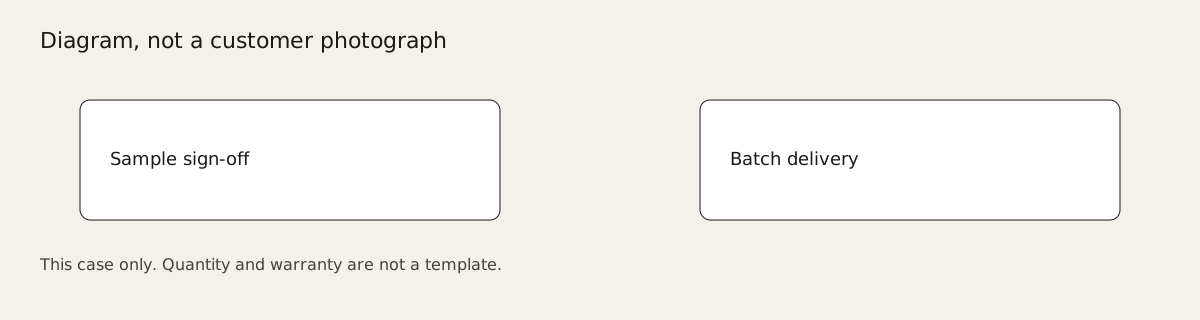
- Customer sign-off on the sample was the gate to batch production — nothing scaled until the reference build was approved.
Send a redacted brief. We reply within 1 business day.
What This Project Demonstrated
- A public-sector deployment can be run as one integrated project: branding, app preload, device control and batch delivery handled under a single delivery responsibility.
- In this program, policy-controlled behavior — lock, allowlist, reset and network restrictions — was checked on a sample and then applied to the same roughly 1,000-unit run. The quantity, the fixed firmware baseline, and the one-year warranty belong to this case. They are not a template for the next program.
- Coordinating brand, software and management work as one program reduces the integration risk a contractor would otherwise carry across multiple suppliers.
- A sample-first, sign-off-gated process gives a clear acceptance point before any batch commitment.
- The model is most useful when procurement, IT and the delivery partner define the acceptance matrix together before scaling.
Where This Pattern Fits
The same controlled-device pattern applies to official desk use and field workforce programs such as customs checks, site inspection and door-to-door survey work. The goal is an issued-device fleet where hardware, software and usage policy match the department workflow, instead of a mixed set of consumer phones adapted after procurement. The device side of that pattern is covered in rugged phones, and the field-record workflow in government field data collection.
Policy, Data and Deployment Architecture
For similar public-sector programs, the management platform can be planned as a cloud deployment or a private deployment depending on data-location and access-role expectations. Audit logs, privacy boundaries and integration responsibility should be agreed before production so the device supplier, integrator and program owner each know where their scope starts and ends.
- App allowlist so only approved official apps run on the device
- Single-app or dedicated-device focus profiles for defined tasks
- Remote lock and device restriction applied centrally by the program owner
- SIM binding and communication policy to constrain connectivity
- Geofence-based rules where the management stack and OEM support it
Procurement and Partner Delivery Model
Public-sector device programs are often delivered through a local system integrator or prime contractor. We can work as the device-program engineering layer behind that partner, including white-label delivery and non-circumvention, so the local project partner keeps the public-body relationship.
- Technical specification and tender support to turn a requirement into a buildable device program
- Sample units or pilot batches validated against an acceptance matrix
- Batch approval tied to clear delivery milestones before the production run
What to send us
| Item | Why we need it | Example format |
|---|---|---|
| Control requirements | Acceptance follows the controls you list | Allow, restrict, or conditional |
| App list | The preload is the workflow | Package names |
| Scale | This case was about 1,000 units; your scale is your own | A range |
| Market | Controls are confirmed for the market | Country |
| Redacted policy matrix | Send the control rows, not a classified file | Control, expected result, owner |
Send a redacted brief. We reply within 1 business day.
Pertanyaan Umum
Why is the customer not named in this case study?
This is a public-sector engagement, so the client name is withheld and details are anonymized to the regional and customer-type level. We describe it only as a Southeast Asian government customs department, with no endorsement implied.
Roughly how many devices were in this deployment?
The program covered approximately 1,000 Android phones delivered as one consistent build, with the same firmware baseline and configuration applied across the batch.
How were the control and management features verified before the full batch?
Each requested control was mapped to a written policy matrix on a sample unit and confirmed through an acceptance test; customer sign-off on that sample was the gate to batch production.
Can the same control profile be applied to any Android device?
No — control and policy features are OEM- and platform-dependent. The enforceable set is confirmed against the chosen hardware and management stack, subject to technical validation, rather than assumed.
Can the management platform run on a private server?
Yes — for similar projects, the management platform can be scoped as a cloud or private deployment so data location and access roles align with the public body, subject to device and management-stack validation.
Can a local integrator stay in front of the public-sector customer?
Yes. Public-sector programs can be structured through a system integrator or prime contractor, with Vantora acting as the device-program engineering layer and preserving the partner’s customer relationship.
Is the device brand or model disclosed?
No. The device brand and model are omitted here because that detail remains unverified for public use; the case focuses on the integration, control and delivery work performed.
Benchmark a Similar Project
End-customer names and commercial information are not required for an initial feasibility review.