- Ownership fixed at provisioning applies to the work-profile and device-owner change this page discusses. It is not a claim about every management migration, and this page adds no migration service.
| Block | Record | Owner |
|---|---|---|
| Identity | Model, build, and market | Named on the spec |
| Firmware | What changed and what was retested | OEM or the project |
| Change rule | Amendment, revision, or a new sample | The approver named in the spec |
What Should an Android Device Build Spec Include?
A build spec identifies the exact device state a project expects to reproduce across hardware, firmware, apps, policy, provisioning, market, accessories, packaging, evidence, owners and change rules.
Diperbarui
The Short Answer
An Android device build spec is a version-controlled project record that states the exact device state a batch is expected to reproduce: which physical device, which firmware build, which application versions, which policy, which provisioning route, which market assumptions, which accessories and packaging — and who owns each of those decisions when one of them moves. It is written as a draft during feasibility, tightened into a sample-candidate revision before a unit is configured, and frozen into an accepted production reference once the sample has been reviewed and approved. Two things make it useful rather than decorative. The first is that every material field carries an approved value, an evidence reference, a named owner and a change rule, so nobody has to guess whether a value was decided or merely typed. The second is that it is paired with a version-controlled sample: the spec says what the state should be, the sample record says what a real unit was observed to be, and acceptance is the moment the two are declared to match within a stated scope. Programs Vantora quotes from around 500 units upward depend on that pairing, because production consistency is only meaningful once there is a reference to be consistent with.
Takeaway. Ownership fixed at provisioning applies to the work-profile and device-owner change this page discusses. It is not a claim about every management migration, and this page adds no migration service.
A Build Spec Is a Controlled Project Record
An Android device build spec is not a consumer data sheet, an Android app build file or proof that the device passed acceptance. It is a version-controlled project record that defines the intended delivery state. “Android device build spec” is Vantora project language rather than an official Android document type, so each material field should identify a state, link to evidence, name an owner and define what happens when that state changes. The discipline is forced by the platform rather than invented for it: almost every value a buyer treats as one thing is several. Android exposes model, product, hardware, SKU and build identifiers as distinct fields; release label, API level, build identifier and security patch level move independently of one another; an application carries a package name, a version code, a version name and a signing identity that are not interchangeable. A spec that collapses any of those into a single friendly phrase has already lost the ability to say whether two units are the same — which is the only question a batch check can actually answer. The corollary matters just as much: compatibility results, licensing, market approval and acceptance evidence stay separate records with their own holders, because a spec that absorbs them becomes the document everyone cites and nobody can verify.
| Published fact | Why it changes the spec | Buyer action |
|---|---|---|
| Android compatibility is established separately through the applicable CDD and CTS path. | A completed project template is not an Android compatibility result or a GMS license. | Link compatibility, licensing, market and acceptance evidence as separate records. |
| Android exposes separate model, product, hardware, SKU and build identifiers. | Runtime identity does not replace the commercial SKU, physical BOM, regional variant or supply source. | Record both procurement identity and captured runtime identity from the accepted sample. |
| Release label, API level, build identifier and security-patch state are separate values. | “Android 14” is not a complete software baseline. | Freeze the observed build, patch, update channel and update owner. |
| Android apps have package, version-code and version-name, plus signing identities. | An app label such as “v2” cannot identify the accepted release or update path. | Record the artifact, both version fields, signing reference, configuration and owner. |
| Ownership mode and provisioning method determine the managed relationship. | The operator’s first setup step is coupled to policy scope and reset behavior. | Record EMM/DPC, ownership, route, starting state, tenant owner and recovery target. |
| Policy definition, reported state and observed app behavior are different evidence layers. | A configured value is not proof that the intended workflow occurred. | Record the profile revision and expected result, then link reporting and observed tests. |
| Update policy can control installation timing where supported, not update supply. | A frozen policy does not guarantee that the OEM or carrier publishes a build. | Name availability, installation, regression, approval and rollback owners. |
What a Version-Controlled Android Device Sample Is
A build spec describes an intention. A version-controlled sample is the physical counterpart: one configured unit whose complete identity has been captured, written down and put under change control, so that any later claim about the fleet can be traced back to something that actually existed on a bench on a known date. The phrase matters because “the sample we sent” is not a record. It names an object, not a state. Three months later nobody can say with confidence which firmware build that unit carried, which application version code was installed, whether the launcher had been updated between the demonstration and the approval, or which policy revision was applied when the tester ran the kiosk scenarios. A version-controlled sample answers all of those from a written record rather than from memory, and it does so because the identity was captured at configuration time rather than reconstructed afterwards. The identity a sample carries has three layers, and each exists for a different reason. Procurement identity — manufacturer, exact model, regional SKU, memory and storage variant, supply route — answers “can this unit be bought again in the target market?”, which is the question a promising sample most often fails months later. Runtime identity — serial number, IMEI, Android release and API level, security patch level, firmware build ID or fingerprint, GMS or AOSP state — answers “is a production unit actually the same software platform?”, and it is captured from the device rather than from the datasheet because the two disagree more often than buyers expect. Configuration identity — application package names with version code and version name, signing and distribution route, launcher package and version, DPC or management agent version, policy profile revision, ownership mode and provisioning route — answers “what was actually applied to this unit?”. On top of those sit the process fields that make the record defensible rather than merely detailed: the configuration date, the named tester, the acceptance matrix revision the unit was tested against, the known limitations accepted with it, and the customer approval date and approver. Without the last group the record is a technical snapshot; with it, the record is a decision. Version control adds three properties that a snapshot does not have. Prior states are preserved rather than overwritten, so a question about a unit delivered in March can be answered against the revision that governed March. Each revision has a scope, naming which lots or tranches it governs, which is what allows a pilot tranche of twenty to a hundred units to run against one revision while the remaining units of the program wait for the next. And every change is attributable — someone raised it, someone approved it, and both are recorded — which is the difference between an amendment and an argument. The mechanics of reproducing an approved state across production units belong to batch staging; what matters here is that staging has a fixed reference to reproduce, and a stop rule that fires when a unit deviates from it.
| Field on the sample record | Why the field exists | What it lets the build spec prove |
|---|---|---|
| Manufacturer, exact model, regional SKU and memory/storage variant | Similar model names hide different radios, memory tiers, market approvals and supply routes | That a production unit can be purchased again as the same physical product in the target market |
| Serial number and IMEI(s) | Identifies the individual unit that produced every test result attached to the project | That an acceptance result belongs to a traceable device rather than to a device family |
| Android release and API level | Policy availability and framework behavior differ across releases and OEM implementations | That the policy design was validated on the platform version production will ship |
| Security patch level | Moves independently of the release label and is a common procurement and audit question | The patch baseline a batch starts from and the gap the update owner is accepting |
| Firmware build ID or fingerprint | The narrowest software identity the device reports; the value an OEM can change silently | Whether an incoming production unit is the same build the sample was accepted on |
| GMS or AOSP state and managed Google Play availability | Determines the distribution route, enrollment assumptions and which services exist at all | That the app delivery and enrollment design matches the platform the units actually carry |
| Application package names with version code and version name | A marketing label such as “v2” cannot identify a release or an update path | Which exact release passed the workflow tests recorded in the acceptance matrix |
| Signing identity and distribution route | A rebuilt or re-signed artifact is a different artifact even at the same version name | That production installs the same signed build, through the same channel, as the sample |
| Launcher package and version | The launcher is updated separately from the app and shapes the first screen the operator sees | That the experience layer under test is the one delivered, not a later build |
| DPC or management agent version and EMM tenant | Agent versions and console feature sets change independently of Android itself | That the observed management behavior came from the licensed stack the project will use |
| Policy profile revision and ownership mode | Ownership mode is fixed at provisioning; policy within that mode is changeable later | Which policy revision produced the recorded behavior, and what a later change may alter |
| Provisioning route and clean-state assumption | The route determines prerequisites, reseller conditions and post-reset recovery behavior | That the enrollment path used on the bench is the path staging and the field will repeat |
| Configuration date and named tester | Attributes the captured state to a person and a moment rather than to the project generally | That the record can be questioned, reproduced or corrected by someone identifiable |
| Acceptance matrix revision the unit was tested against | Results are only meaningful against the scenario list that was in force at the time | Which scenarios were actually run, and which were out of scope on the approval date |
| Known limitations accepted with the sample | Residual gaps are decisions, and undocumented decisions resurface as disputes | That the approver saw the exceptions before signing rather than discovering them later |
| Customer approval date and named approver | Turns a technical snapshot into an authorization with a scope and a date | The point from which change control applies and revalidation triggers begin to run |
How the Sample Record and the Build Spec Reference Each Other
The two records answer different questions and should not repeat one another. The build spec is prescriptive: it states the intended value of every material field, the tolerance or variance permitted around it, the owner and the change rule. The sample record is descriptive: it states what one real unit was observed to be, on a date, tested by a named person. Acceptance is the moment those two are compared and declared to match within a stated scope, and that comparison is only possible because the two records use the same field names in the same order. The linkage should be explicit and narrow. The build spec carries the sample ID and the sample revision it was accepted against; the sample record carries the build-spec revision it was configured from and the acceptance-matrix revision it was tested against. Nothing else is copied across. When a value is duplicated in both documents it will eventually be updated in one and not the other, and the project then has two truths and no way to tell which one governed a shipped batch. Where a value genuinely has to appear in both — the firmware build ID is the common case — one document owns it and the other references it, and the reference states which document is authoritative. Residual gaps go somewhere else again: a limitation that was accepted rather than fixed belongs in the known-limitations library with an owner and a revalidation trigger, not buried as a caveat inside a spec field, because a field that reads as approved is treated as approved by everyone downstream.
Use Seven Sections and Four Field Controls
For every material field, record an approved value or bounded range, an evidence reference, the confirming owner and the variance or change rule. An unresolved field stays open with an owner and decision point; it should not be filled with a plausible guess. Those four controls are what separate a specification from a wish list, and applying them is usually more revealing than the values themselves — a field that nobody will own is a field that nobody has decided. Structure the record so a reviewer can establish in one pass whether the physical device, the software platform, the application state, the management design, the market and kit, and the evidence trail have each been settled by someone with authority to settle them. What most specs skip is the boundary — stating what each section deliberately does not cover — and skipping it is how certification conclusions and commercial terms drift into a delivery baseline. Keep secrets out of it entirely: enrollment tokens, administrator credentials and signing material are referenced by location and custodian, never pasted into a record that will circulate as an attachment.
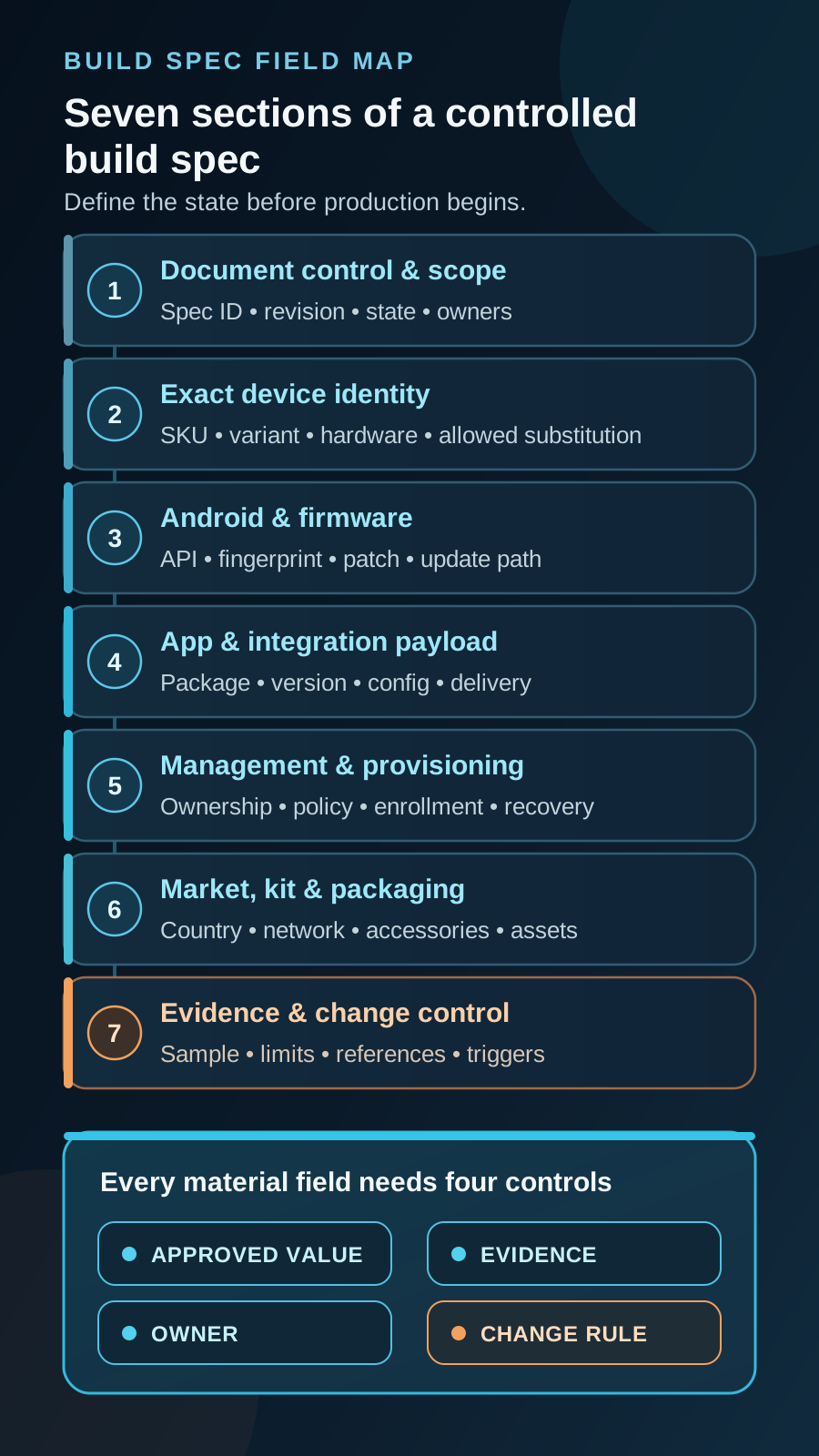
| Section | Minimum controlled content | Boundary |
|---|---|---|
| Document and scope | Spec ID, revision, status, scope, market, use case, owners and linked sample. | State whether it is a draft, sample candidate, accepted reference or superseded record. |
| Physical device | Manufacturer, exact model/SKU, regional variant, memory, supply route, substitutions and critical hardware. | Runtime fields alone do not prove the physical configuration. |
| Android and firmware | Release, API level, build ID/fingerprint, patch, relevant system state and update rule. | Keep compatibility, GMS, market and future support commitments separate. |
| App and integration | Package, artifact or track, version code/name, signing reference, permissions, configuration and dependencies. | An installed artifact does not prove the workflow. |
| Management and provisioning | Ownership mode, EMM/DPC, policy revision, enrollment route, tenant owner and recovery target. | Reference protected credentials rather than copying secrets into the spec. |
| Market and physical kit | Countries, network assumptions, locale, charger, accessories, labels, branding, inserts and packaging revision. | Link market and physical evidence to its holder and authority. |
| Evidence and change | Sample and matrix revisions, limitations, deviations, staging references and revalidation triggers. | Preserve prior revisions and identify the lots governed by each release. |
Replace Vague Labels with Controlled Clauses
The goal is not more words; it is fewer interpretations. Use placeholders while the spec is a draft, but do not let an accepted production reference hide a material unknown behind “TBD,” an unlabeled screenshot or an inaccessible link. The pattern that separates a vague label from a spec-worthy clause is consistent: the label names an outcome, the clause names the value, the mechanism, the owner and the permitted variance. “Latest firmware” is the clearest example, because it is not a state at all — it is a moving target that resolves differently on the day each unit is staged, which is precisely how two tranches of the same order end up on different builds. “Same as accepted sample” is the most dangerous, because it sounds like the strongest possible commitment while delegating the entire definition to a record that may not be under version control. For each of these there is also evidence that belongs elsewhere, and pulling it into the spec is how a delivery baseline turns into an unreviewable document that nobody trusts enough to update.
| Vague phrase | Spec-worthy record | Keep separate |
|---|---|---|
| Latest firmware | Approved build ID/fingerprint and patch baseline, update owner and permitted update rule. | OEM release commitment and update test evidence. |
| App preloaded | Package, version code/name, artifact or track, install method, configuration and update owner. | App test results and private signing material. |
| Kiosk enabled | Ownership mode, policy revision, allowed app set, exit and recovery owner, and known gaps. | Observed kiosk tests and administrator credentials. |
| Standard charger | Electrical and connector requirement, regional plug, approved part, substitution rule and pack quantity. | Safety or market evidence and incoming inspection. |
| Same as accepted sample | Sample ID, build-spec revision, acceptance-matrix link and explicitly allowed differences. | The acceptance evidence and per-unit batch results. |
Keep the Rollout Records Separate
The build spec defines the target state. Adjacent records define the need, the proof and the unit-level execution. Keeping them separate preserves traceability and stops one document from pretending to answer every rollout question. The practical test is to ask which record a disagreement should be settled against. If the argument is about whether a requirement was ever agreed, that is the requirements brief. If it is about what the delivered state was supposed to be, that is the build spec. If it is about whether the state was proven to work, that is the acceptance matrix, which holds scenario, expected behavior, observed behavior, verdict and owner. If it is about which units received which state, that is the staging or batch record. Merging any two of these produces a document that cannot answer either question cleanly: a spec that carries test results becomes stale the moment a scenario is re-run, and an acceptance matrix that carries field definitions becomes the place people go to look up production values that were never maintained there. The separation also decides who may change what — and the single rule worth stating explicitly is that a staging record never authorizes a change to the approved state. It records that the state was applied, or that a unit deviated and was stopped.
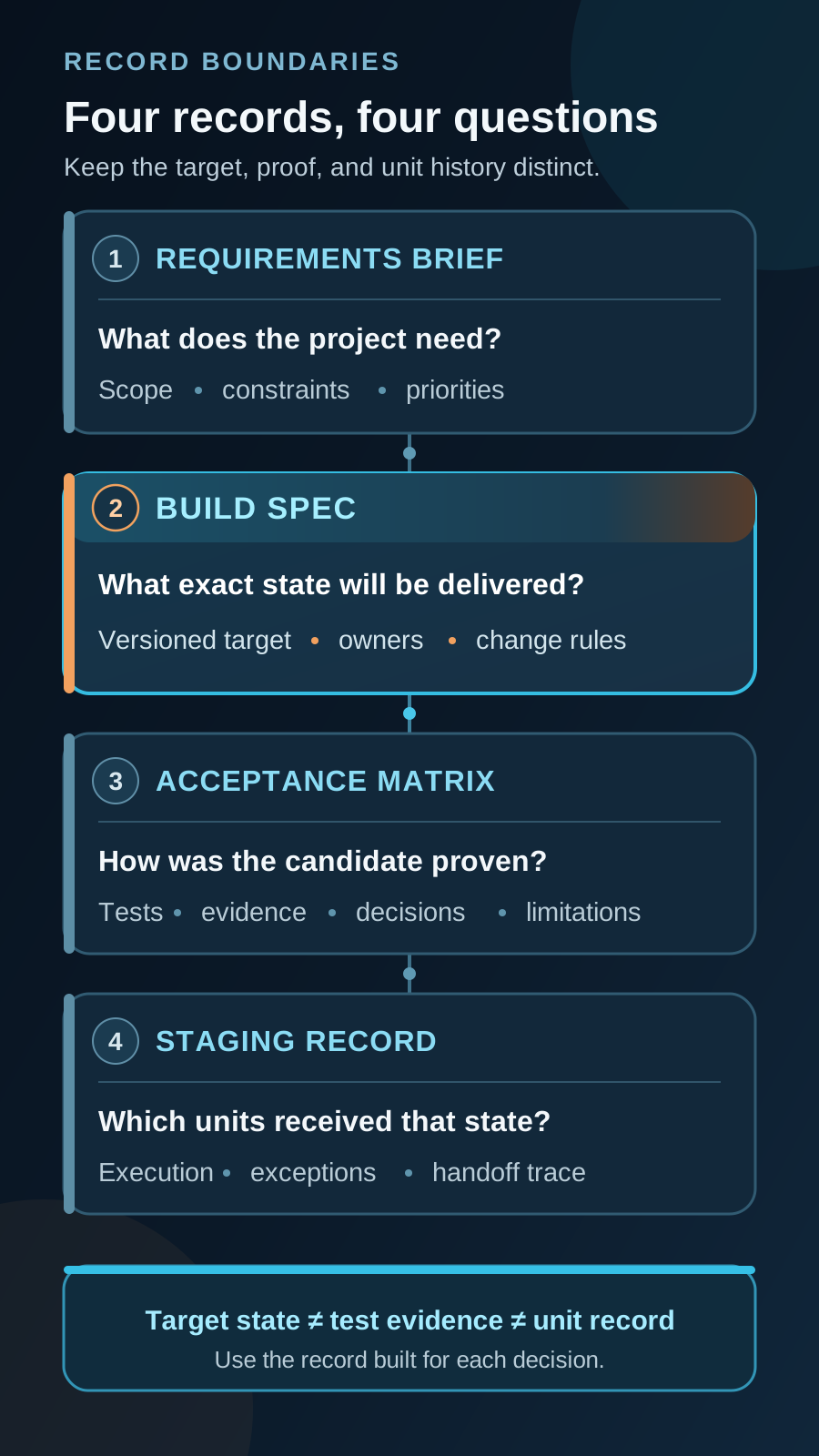
| Record | Primary question | It should not replace |
|---|---|---|
| Requirements brief | What does the project need and why? | The final configuration or proof that it works. |
| Build spec | What exact state is intended for delivery? | A test result, quotation or unit execution log. |
| Acceptance matrix | How was the candidate checked and what was accepted? | The definition of every production field. |
| Staging instruction or batch record | How is the approved state applied and which units received it? | Permission to change the approved state. |
Freeze the Reference, Then Control Change
A device SKU, hardware revision, firmware fingerprint, patch baseline, app artifact, signing path, policy, provisioning route, market assumption, accessory, branding asset or package can all change the build. Open a controlled revision, compare it with the current reference, identify affected evidence and acceptance rows, assign owners and obtain the required decision before the new state is used. The four states below are worth naming explicitly on the document itself, because most of the confusion in a device project comes from people reading a draft as though it were an approval. A draft invites challenge; a sample-candidate revision is a commitment to configure a unit a particular way; an accepted production reference is an authorization with a scope and a date attached; a superseded revision is retained evidence, not a mistake to be deleted. Where those checkpoints sit in the wider sequence — feasibility, sample, acceptance, staging, handover — is set out in how a validated Android device rollout works.
- 1Feasibility draft: confirmed requirements, candidates, unknowns and owners without implying acceptance.
- 2Sample-candidate revision: the exact configuration the sample is intended to represent.
- 3Accepted production reference: authorized sample decision, limitations and evidence for a defined scope.
- 4Superseded revision: retained after a newer approved revision takes effect.
Revision or Amendment: What Each Change Triggers
Once a reference is accepted, every proposed change needs a route, and there are only three. An amendment corrects the document without altering the device state — a corrected owner name, a wording clarification that does not change an approved tolerance, or a link that had gone stale. Changing an approved tolerance is a revision, not an amendment. An amendment is recorded, dated and attributed, but it does not touch acceptance and does not require the approver to look at the device again. A revision changes the intended state, which means a new revision number, a diff against the previous reference, an assessment of which acceptance rows are affected, and a decision by the approver named in the document before any unit is staged to it. A substitution or a change of ownership mode is a third case: it produces a new sample rather than a revision, because the thing being validated is no longer the thing that was validated. The dividing line is not the size of the change but whether the evidence still applies. A cosmetic packaging insert can be an amendment; a charger swap cannot, because the electrical and market evidence attaches to a part number. A policy change from fully managed to a dedicated configuration is a revision, since dedicated use is a subset of the fully managed model and the change is applied as policy on an already-provisioned device. A change from a work profile to device-owner management is not a revision at all, because ownership is fixed at provisioning and cannot be switched from a console; the device is re-provisioned from a clean state, and a new sample is configured and accepted. That asymmetry is the single most useful thing to know before writing a mode into a purchase specification, and the modes themselves are compared in dedicated vs fully managed Android devices. Approval authority should be written into the spec rather than assumed. In most programs the technical owner assesses impact, the customer approver authorizes anything that changes accepted behavior or cost, and staging holds until the authorization exists. The point of naming them is that the expensive failure is not a bad decision — it is a change that reached production because nobody was clearly responsible for saying no.
| Change observed | Route | Who authorizes | What must be re-proved before staging continues |
|---|---|---|---|
| Corrected owner name, clarified wording, stale link repaired | Amendment — same revision, dated and attributed | Document owner | Nothing on the device; the amendment log records what changed and why |
| New security patch level on the same firmware branch | Revision, unless the spec states a patch range that already covers it | Technical owner, with the update owner informed | The scenarios the patch could plausibly affect — enrollment, policy application and the app first-run path |
| New firmware build ID shipped by the OEM | Revision against the accepted reference | Technical owner assesses; customer approver authorizes | A regression pass on the acceptance rows tied to policy, kiosk behavior, peripherals and the app workflow |
| New application version code, or a rebuilt artifact at the same version name | Revision — the artifact identity has changed | Software owner, with the customer approver where behavior changes | First run, authentication, permissions, offline behavior and update path on the accepted build |
| Signing key or distribution route change | Revision, and a re-check of the install path | Software owner and customer approver | That the artifact installs and updates cleanly through the managed channel on a clean-state unit |
| Policy profile change — allowlist entry, restriction, lock task feature | Revision of the policy field with the new profile version | IT owner; customer approver where a control is relaxed | The affected control, plus the bypass scenarios that the control was closing |
| Fully managed reconfigured as a dedicated, locked configuration | Revision — a policy change on an already-provisioned device | IT owner and customer approver | Lock task behavior through reboot, notification, call and app restart, plus the approved staff exit route |
| Work profile to device-owner management, or the reverse | New sample — ownership is fixed at provisioning and cannot be switched from a console | Customer approver, as a scope change | The full enrollment path from a clean state, and the acceptance rows that depend on management scope |
| Regional SKU, memory variant or hardware revision substitution | New sample for the substituted variant | Customer approver, on a documented substitution request | The scenarios that depend on radios, market fit, memory headroom and peripheral behavior |
| Charger, cable or accessory substitution | Revision naming the approved part and the substitution rule | Procurement owner, with the market-evidence holder | That the substituted part carries its own market and safety evidence and passes incoming inspection |
| EMM platform, tenant or DPC/agent change | New sample where the management stack changes; revision for an agent version bump | IT owner and customer approver | Enrollment, policy application, reporting and remote commands on the new stack or agent version |
| Packaging, label or insert revision | Amendment for wording; revision where a regulated marking or asset-tag scheme changes | Operations owner | A packaging proof against the revised artwork, and label placement checked on a staged unit |
Takeaway. An amendment may clarify wording. It does not change an approved tolerance or the device state. A real tolerance change is a revision and is judged again.
Send a redacted brief. We reply within 1 business day.
When the OEM Ships a New Firmware Build After Acceptance
This is the most common way an approved sample quietly stops representing the fleet, and it deserves a stated rule rather than an improvised response. A build spec can freeze the value it records; it cannot freeze what a manufacturer or carrier publishes. Devices bought weeks after acceptance may leave the factory on a newer build, and a device that reaches the field can update itself unless the update path is controlled. Android exposes a system update policy that a device policy controller acting as device owner can use to postpone or window installation where the OEM supports it, and that is worth applying — but it governs installation timing on a managed device, not what arrives preloaded on an incoming lot, and its behavior is OEM- and platform-dependent. The workable response has four parts. Detect it: incoming units are checked against the recorded build ID or fingerprint during staging, so a mismatch is found on the bench rather than at a customer site. Classify it: a patch-level move within the same firmware branch is usually narrower than a new build ID, and a spec that states a patch range explicitly avoids reopening the reference for every monthly bulletin. Scope the retest: rather than re-running the whole matrix, re-run the acceptance rows that plausibly depend on the platform — enrollment from a clean state, policy application, lock task behavior, peripheral drivers, and the application first-run and permission path. Decide and record: the new build either becomes a revision of the accepted reference, or the affected units are held and the difference is escalated. Whichever way it resolves, the outcome is written into the spec and, where a difference is accepted rather than fixed, into the known-limitations log with an owner. The failure mode to design against is the silent one — units shipped on a build nobody compared, discovered only when a subset of the fleet behaves differently and there is no record of what changed. The rule above is the specification-side answer: what the reference says, and what authority moves it. The bench-side answer — how an incoming lot is actually checked, what a mini-pilot re-verification looks like on a repeat order, and how mismatched units are held out of the release stream — belongs to Android device batch staging.
How a Substitution Request Is Evaluated
Substitution requests arrive for ordinary reasons: a variant goes end-of-life, a memory tier becomes scarce, an accessory is discontinued, a lead time slips past the delivery window. They are legitimate, and refusing them outright is not a policy — but accepting one on the strength of a similar specification sheet is how a program acquires a defect it cannot explain. A useful evaluation runs in a fixed order. First, identify what actually differs: not the marketing model name but the fields the spec controls — SKU, radios and band support, memory and storage, firmware branch, GMS or AOSP state, peripheral or accessory part number, market approvals. Second, map each difference onto the acceptance matrix and mark the rows it could touch; if a difference touches no row, the spec is probably not controlling something it should. Third, decide the route using the rule above: a different regional SKU or hardware revision is a new sample, an accessory swap is normally a revision with a named part and a substitution rule. Fourth, cost the evaluation honestly in time as well as money, because a substitution that arrives late in a program competes directly with the delivery date it was meant to protect. Fifth, record the decision — including a refusal — so the same request does not return without new information. Two guardrails are worth writing into the spec in advance. Name which fields are substitutable at all, so procurement knows before it asks; and state that any substituted variant enters the program through the same sample and acceptance path as the original, typically confirmed on a small tranche before the remaining units of a program are staged. That pre-agreement is what keeps a substitution a scheduling problem rather than a re-negotiation.
Download the Device Build Spec Template
Use the template to capture the intended device platform, software and application state, policy, packaging, accessories, evidence and staging references. Keep secrets and commercial terms in their controlled systems, and connect the final revision to the sample and acceptance evidence that support it. If a project already has a specification in another format, the useful exercise is not to rewrite it but to test it against the four field controls: does each material field carry an approved value, an evidence reference, a named owner and a change rule? Fields that fail that test are where a rollout usually goes wrong, and they are cheap to fix while the spec is still a draft. Where the wider readiness question is still open — whether a device that enrolls successfully is actually ready for a batch — start from MDM-ready vs rollout-ready Android devices, then bring the target model, application, management platform, markets and quantity range so the spec can be built against real constraints.
What to send us
| Item | Why we need it | Example format |
|---|---|---|
| Current spec version | Change control starts from the accepted revision | Spec id and revision |
| Sample id | The spec has to point at a device | Sample record id |
| Change diff | A clarification is not a new tolerance | What changed, in words |
| Evidence link | The revision has to point at a record | URL or file name |
| Owner | Someone accepts the revision | Role name |
Send a redacted brief. We reply within 1 business day.
Pertanyaan Umum
Is an Android device build spec an official Google or Android standard?
No. Here it is a project-controlled artifact. Android compatibility, app versioning and device management have official definitions, but Google does not prescribe this Vantora build-spec structure.
What makes a device sample “version-controlled” rather than just a sample?
A version-controlled sample has its full identity captured in a dated record — model and regional SKU, serial and IMEI, Android release and security patch level, firmware build, GMS or AOSP state, app packages with version codes, signing and distribution route, launcher version, DPC or agent version, policy revision, provisioning route, tester, acceptance-matrix revision, accepted limitations and the approval date. Prior revisions are preserved rather than overwritten, each revision states which lots it governs, and every change is attributable to a person. Without that, “the sample we sent” names an object but not a state, and nothing downstream can be checked against it.
Is the build spec written before or after the sample?
Both, with different states. A draft guides feasibility and the sample candidate. After authorized review, it can become an accepted production reference for the defined scope.
What happens if the OEM changes the firmware after the sample is approved?
The change is detected during staging by comparing incoming units against the recorded build ID or fingerprint, then classified — a patch-level move within the same branch is usually narrower than a new build ID. The acceptance rows that plausibly depend on the platform are re-run rather than the whole matrix: clean-state enrollment, policy application, lock task behavior, peripherals and the application first-run path. The result becomes either a revision of the accepted reference or a hold on the affected units. A managed system-update policy can control installation timing on enrolled devices where the OEM supports it, but it does not determine which build arrives preloaded on a new lot, and its behavior is OEM- and platform-dependent.
Is a manufacturer data sheet enough?
No. It rarely fixes the exact regional SKU, firmware fingerprint, app artifact, policy, provisioning route, packaging, limitations, owners and change rules required by the project.
Does a build spec require a custom ROM?
No. A standard commercial device, configured model or deeper-custom product can all use a reproducible configuration record.
Can the build spec change after production begins?
Yes, through a controlled route. An amendment corrects the document without changing the device state. A revision changes the intended state and needs a diff against the previous reference, an assessment of affected acceptance rows and the named approver’s decision before staging continues. A substitution of the regional SKU or hardware revision, or a change of ownership mode, produces a new sample instead, because the evidence no longer applies to what is being built.
Ceritakan alur kerja dan aturan Anda.
Kami mengubah persyaratan menjadi perangkat yang siap diterapkan.