- 1. Check the Real App Workflow
- 2. Check the Exact Hardware and Market Variant
- 3. Check App Delivery and Version Identity
- 4. Check First Run, Permissions and Configuration
- 5. Check Management, Kiosk and User Boundaries
- 6. Check Updates, Recovery and Change Control
- 7. Check Sample Acceptance
- 8. Check Batch Staging and Handoff
App-Ready Android Device Checklist for SaaS and Software Teams
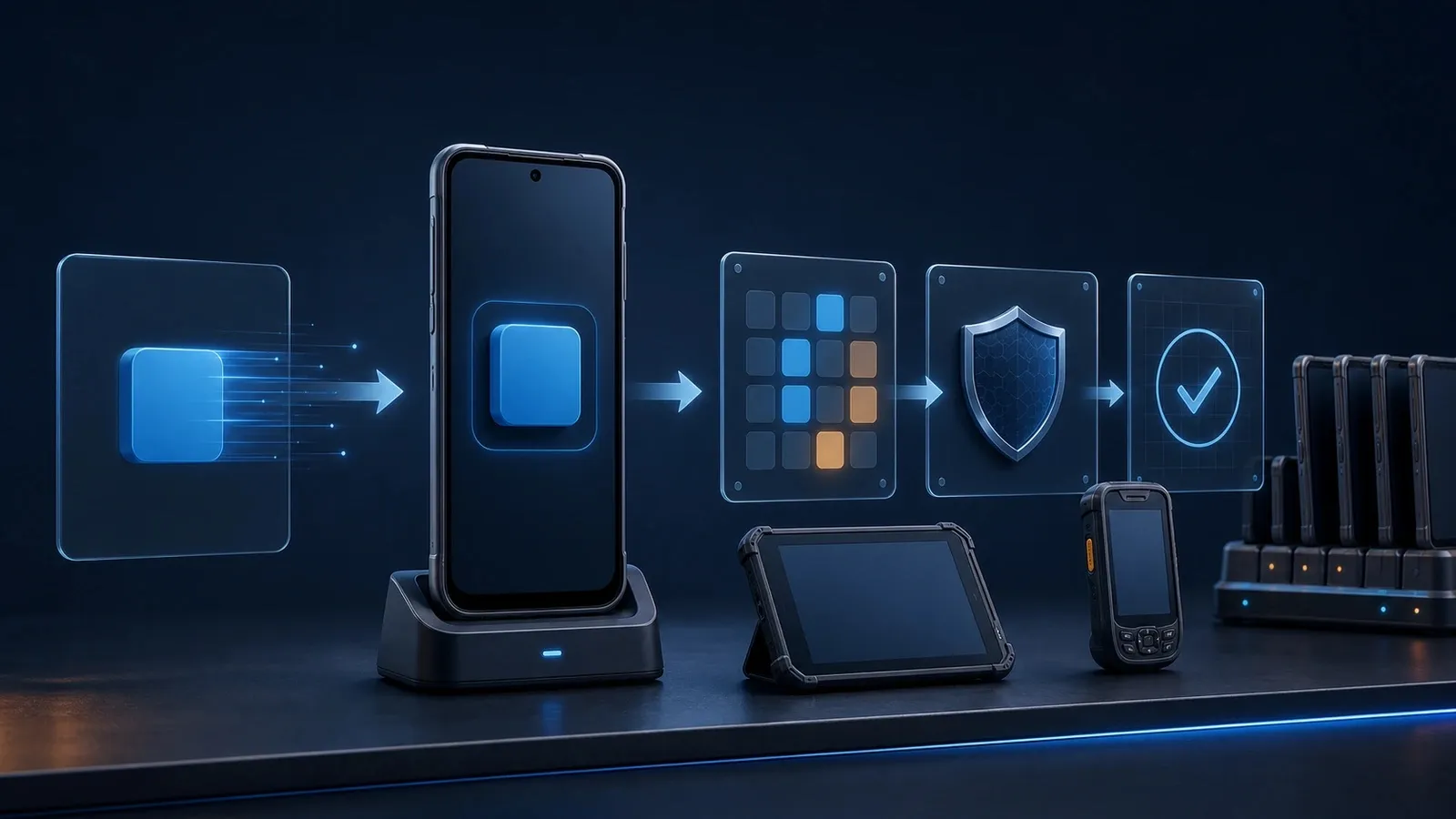
An app-ready Android device is not simply a phone or tablet with an APK installed. For a specific project, it is a recorded device-and-software baseline on which the approved app can be delivered, launched, configured, operated, updated, recovered and supported under the intended conditions — and then reproduced across a batch.
Diperbarui
The Short Answer
This checklist helps SaaS and software teams decide whether the evidence for an app-ready device actually exists before a batch is committed. “App-ready” is a Vantora project term in this guide, not a Google or Android certification. The project team must connect Android’s separate compatibility, permission, distribution, management and update mechanisms to one real workflow on one exact build. Delivered as a program rather than a checklist, that is what branded, app-ready Android devices covers.
Installed Is Not the Same as App-Ready
An installation test proves that a package can reach the tested device through the tested route. It does not prove the operating journey. Android defines app compatibility against a specific platform version and notes that platform changes can affect apps, so validate the target Android and firmware build — see Android’s app compatibility guidance.
| Evidence level | What it proves | What it does not prove |
|---|---|---|
| Package installs | The tested package can be installed through the tested route | Login, permissions, offline behavior, peripherals, updates or recovery |
| App launches | The opening screen appears on the tested build | Completion of the real user workflow or background behavior |
| Device enrolls | The selected management route can enroll this test device | App readiness, kiosk recovery, regional fit or batch repeatability |
| Sample passes | The recorded sample meets agreed scenarios | Every future app, firmware, backend, model or market condition |
| Batch is staged | Production units were prepared against a defined process | Field success unless identifiers, exceptions, handoff and support are also controlled |
Record the Baseline Before Testing
Do not approve “the Android version” or “the APK” in the abstract. Give the reference sample a build record. At minimum, capture the exact device model and regional SKU, Android and firmware build, app package and version, signing source, distribution route, management mode, policy version, peripherals, network assumptions, target markets and date tested. When the application includes real-time voice or video, extend that baseline with the call profile and sample evidence in the Android hardware guide for WebRTC video calling.
How to Test the Build on a Candidate Device
Most checklists state what to verify and leave the method implied, which is where evaluation quietly goes wrong: the tests are run, they pass, and they prove less than the team believes. Start with the install route, because it changes the meaning of every result that follows. During evaluation an engineer will normally push the build over adb from a workstation with USB debugging enabled, and that is a reasonable way to iterate on a functional defect quickly. It is not the route the fleet will use. A managed install driven by a device policy controller happens with no user present, potentially before anyone signs in, under the restrictions the policy already applies, and with the installation attributed to the managed channel rather than to a local session. The production restriction set is the part that catches teams out: a policy that disallows install from unknown sources, or that blocks USB debugging or app installation outright, closes the route the evaluation depended on, so the package that installed cleanly on a bench unit has no path onto a production device at all. Test the managed route on the candidate before treating the app as installable, and keep sideloading for debugging iterations that are re-tested afterwards. The delivery-route framework itself is set out in preload apps on Android devices at scale; the point here is narrower — the route used to run a test is part of that test’s result. Next, confirm the architecture actually being delivered. Devices report a primary and a secondary ABI, commonly arm64-v8a with 32-bit support where the platform still provides it, and Android’s ABI documentation describes how a package’s native libraries are matched to the device. Wrong-ABI failures rarely look like ABI failures: either installation is refused because no native code matches, or installation succeeds because the package happens to carry a usable library folder and the app dies later with a native-library load error the first time the scanner, camera pipeline or cryptography module is exercised. If the app ships as an Android App Bundle, the universal APK a tester sideloads and the split a managed channel generates for that specific device are not the same artifact, so record which one was tested and reconcile it against what the fleet will receive. Version boundaries deserve the same literalism. The minimum and target API levels declared in the manifest decide both eligibility and behavior: a candidate running an Android version below the declared minimum is filtered out of a managed channel rather than shown an error, so the symptom is a device that never receives the assignment at all, while the target level selects which platform compatibility behaviors apply. Google also enforces a rolling target API level requirement for new uploads, so an older internal build can be perfectly testable and still not be publishable through the channel the program intends to use. Then test the build the fleet will get, not the one the developer has open. A debug build differs from the release candidate in ways that hide real failures: a different signing key, the debuggable flag set, code shrinking and obfuscation reduced or skipped, verbose logging retained, and — a frequent late surprise — the debug overrides in the network security configuration active, so an internal or self-signed certificate that worked throughout evaluation stops working in the signed release. Shrinking brings its own class of defect, since reflection, serialization and dependency injection tend to break only once obfuscation is applied. Signing identity then matters beyond the first install, because update acceptance depends on it; settle signing custody, described under app signing, before the sample is accepted rather than after. Run all of it on the exact regional SKU that will be ordered. One model family can share a marketing name across model numbers that differ in radio bands, memory tier, preinstalled software, firmware channel, default locale set and, in some markets, whether Google services are present at all — a lookalike unit borrowed from a colleague is a useful bug-finding device and a poor acceptance device. Finally, capture the same fields from every run, or the results cannot be compared later: device model and model number, build fingerprint and security patch level, package name with version name and version code, signing certificate digest, install route, policy version in force, tester and date, plus the raw artifacts — a log extract around any failure, a recording of the workflow, and any crash or ANR record. That set is what lets a test result become a row in the acceptance matrix, and what lets batch staging reproduce the tested conditions rather than approximate them.
| Test area | Method that produces usable evidence | Evidence to capture | Common failure it exposes |
|---|---|---|---|
| Getting the build onto the device | Iterate over adb where useful, but repeat the decisive run through the managed or preload route the fleet will use, on a device already carrying the production restrictions | Install route, policy version in force, installer attribution, timestamped result from a clean device | A package that installs by sideload and is refused once installation from unknown sources is blocked |
| CPU architecture and native libraries | Install on the candidate and exercise every native-backed function — scanner, camera, cryptography, mapping, media — not only the launch screen | Device ABI list, native libraries present in the package, whether a universal APK or a per-device split was tested | Installation refused for no matching native code, or a native-library load error at first real use |
| Android version boundaries | Compare the declared minimum and target API levels against the candidate build, then confirm the app is actually offered through the managed channel | Android version, API level, build fingerprint, assignment state shown in the console | A device that silently never receives the app because it falls below the declared minimum |
| Build type | Run acceptance on the release-signed, shrunk and obfuscated build; treat debug builds as engineering tools only | Build type, signing certificate digest, whether shrinking was enabled, network security configuration in effect | Certificates that only validated under debug overrides; reflection or serialization broken by obfuscation |
| Update identity | Install the accepted version, then apply the next version through the same channel and record the outcome | Application ID, version codes before and after, signing certificate continuity, update result | An update rejected because the identity or signing condition is not met after a channel or custody change |
| Device variant | Test the exact regional SKU and firmware channel that will be ordered, not a same-name lookalike | Model number, regional SKU, firmware build, security patch level, services present on the build | Behavior confirmed on one variant and missing on the ordered one — bands, preinstalled software, services or power management |
| First run and permissions | Run first launch on a clean, freshly provisioned device with the production policy applied, including each denial path | Prompt sequence, granted and denied state per permission, configuration delivered, screen recording | A first run that only works because the tester had already granted permissions by hand on that unit |
| Background execution | Unplug, lock and leave the device for a realistic shift; force the idle state deliberately during engineering runs | Unplugged runtime, sync events delivered against expected, battery drain, process kills, ANR and crash records | Overnight sync loss that never appears on a plugged-in bench device |
What a Desk Test Hides: Background Execution and Power Policy
A ten-minute test on a plugged-in device with the screen on exercises almost none of the platform behavior that decides whether the app still works at the end of a shift. Android actively restricts what an idle device permits: Doze and app standby defer background work, alarms and network access when a device is unplugged, stationary and dark, releasing them in maintenance windows, and app standby buckets reduce how often a seldom-used app may run at all. A device on a charger never enters that state, which is exactly why the desk test passes. The evaluation protocol therefore has to force it — unplug the unit, lock it, leave it for a realistic shift, and during engineering iterations put the device into the idle state and a low standby bucket deliberately rather than waiting for the platform to get there on its own. Long-running work also needs a mechanism the platform will honor. A foreground service is user-visible and, on recent Android versions, must declare a service type with a matching permission and be started under conditions the platform allows; deferrable work belongs in scheduled jobs; and exact alarms are restricted to app categories that qualify for them. An app built around a plain background thread and an exact alarm can behave for a week on a bench and then miss its overnight sync across the fleet. Battery-optimization exemptions are the part most often assumed rather than verified. An exemption changes how the platform treats the app, but obtaining one is a policy question rather than an app setting: on an unmanaged device it runs through a user-visible prompt, while on a fully managed or dedicated device an EMM may be able to apply it — and separate OEM power-management layers can sit above the platform behavior and stop apps under rules the Android documentation does not describe. Those layers are OEM-, model- and firmware-dependent and have to be confirmed on the candidate rather than inferred from platform documentation. Two consequences follow for the rollout. First, whichever exemption the app depends on has to be part of the policy version that batch staging applies; otherwise the sample passes with an exemption a tester set by hand and the batch ships without it, which is the ordinary gap between one working device and a fleet. Second, the dependency belongs in the known-limitations library with a revalidation trigger, because a firmware update can change power-management behavior without anything in the app changing at all. The same reasoning applies to everything else a tester configured manually on the sample: if it is not in the recorded baseline, it does not exist on the batch.
- Charged and plugged in — the device never enters the idle state where background work is deferred.
- Screen on and unlocked — no keyguard, no standby demotion, no maintenance-window timing.
- Developer options and USB debugging enabled — a state the production policy will normally not allow.
- Strong Wi-Fi, fresh tokens and an empty local database — none of which describes hour eight of a shift.
- Exemptions and settings applied by hand on one unit — absent from the batch unless the policy applies them.
1. Check the Real App Workflow
A generic device benchmark cannot answer these questions. Hardware should be selected around the job the app performs, not around a headline processor or memory number.
- The primary user, task, environment and success outcome are defined.
- Representative login, tenant, role and account-recovery paths are available for testing.
- Online, weak-network, offline, sync and interrupted-session behavior are covered where relevant.
- Required camera, NFC, barcode, printer, scanner, dock, Bluetooth or USB interactions are listed.
- Backend, certificate, VPN, domain, time, location or API assumptions are recorded.
2. Check the Exact Hardware and Market Variant
These are feasibility inputs, not universal product claims. Compare mainstream, rugged or deeper OEM routes against the requirements before committing quantity.
- Screen, memory, storage, CPU architecture, camera, sensors and ports fit the workflow.
- Battery, charging, accessories, mounting and environmental needs are realistic for the operating shift.
- The exact regional SKU — not only the model family — is recorded.
- Cellular bands, carrier fit, certifications, importer obligations and target-country assumptions have named owners.
- Model availability, replacement route and likely lifecycle fit the program.
3. Check App Delivery and Version Identity
Choose a delivery route deliberately: managed Google Play, an agreed preload or controlled APK staging. They are not interchangeable. Google documents that managed Google Play can install apps through device policy and can restrict a private app to one enterprise — see the managed app distribution documentation. That is useful for supported managed deployments, but it does not make the same route available on every AOSP, non-GMS, OEM or unmanaged build.
- Package name, version code, release channel and signing owner are recorded.
- The selected route works from the intended clean-device state.
- Private-app visibility and tenant assignment are correct where managed Google Play is used.
- Installation failure, interrupted download and reinstall behavior have a support path.
- The production batch will receive the same approved package and route.
4. Check First Run, Permissions and Configuration
An app can install cleanly and fail at its first permission prompt. Android requires dangerous permissions to be requested at runtime on supported modern versions, and the app must handle a denial rather than assume access — test the actual prompt sequence, rationale, grant, denial and recovery behavior described in Android’s runtime-permission workflow. For remote configuration, confirm that the app exposes and consumes the required fields: Android’s managed-configuration guidance makes the app responsible for defining its schema, and an EMM cannot invent unsupported fields.
- First launch reaches the intended screen without undocumented manual steps.
- Required permissions are requested in context and denied permissions fail safely.
- Account, tenant, language, region, certificate and endpoint configuration are correct.
- Reboot, relaunch, logout, token expiry and agreed reset scenarios are tested.
- No production credentials, signing keys or unnecessary customer data are embedded in the build.
5. Check Management, Kiosk and User Boundaries
First decide whether the device is personally owned, company owned with mixed use, fully managed or dedicated. In Android Management API, the enrollment token and provisioning method establish ownership and management mode — see Google’s provisioning documentation. Other EMM architectures may differ, so verify the selected platform rather than copying an example policy. Google’s dedicated-device policy example can auto-launch a designated kiosk app at boot; it is one implementation example, not a universal control promise.
- Enrollment repeats from the intended factory-reset or clean state.
- App assignment, policy, restrictions, network settings and reporting reach the right tenant and group.
- Single-app, multi-app, custom-launcher, allowlist and support-access requirements are explicit.
- Reboot, lock, unlock, reset, policy refresh and unacceptable escape paths are tested.
- The support team has a recovery path that does not depend on an unknown password or hidden setup step.
6. Check Updates, Recovery and Change Control
The first version is only the start of the device program. Android accepts an app update only when identity and signing conditions are satisfied: the application ID must match, the signing certificate must match or use a valid proof of rotation, and the version condition must be met — review Android’s app-update rules before changing distribution channels or signing custody. Google’s Android Management API update guidance describes conditional default, high-priority and postpone modes for managed apps; these do not control OEM firmware releases.
- App release ownership, signing custody, approval and deployment timing are documented.
- The chosen channel’s normal, urgent and staged-release behavior is understood.
- Failed-update, interrupted-update, data-migration and recovery scenarios are tested where material.
- Firmware, app, backend, policy and peripheral changes have revalidation triggers.
- “Rollback” is not promised unless the exact channel and app data model support a tested recovery route.
Send a redacted brief. We reply within 1 business day.
7. Check Sample Acceptance
Convert each critical expectation into a pass criterion, test method, observed result, evidence reference, owner and disposition. Use Pass, Conditional, Fail or Not Applicable only when the meaning is defined. The Sample Acceptance Matrix is a useful structure, but the project’s named authority — not the template — decides what is sufficient for release.
- The accepted sample is physically identified and tied to its build record.
- Critical user workflows pass on the exact sample configuration.
- Conditional items show dependency, impact, owner, closure condition and whether batch work may proceed.
- Failed critical items block release until a named authority approves a new path.
- Screenshots, logs, recordings, console records or inspection notes support material results where appropriate.
8. Check Batch Staging and Handoff
Staging turns the accepted sample into a controlled batch — and handoff decides whether the receiving team can actually operate it.
- Production units are prepared from the accepted app, firmware, policy and setup baseline.
- Serial, IMEI, asset, site, tenant, SIM/APN, accessory, label, carton and exception records are captured as applicable.
- QA compares the batch with the reference sample and includes a stop rule for material deviation.
- Activation, replacement, warranty, support, escalation and reorder instructions are ready.
- The receiving team knows which actions remain at site and which state should already exist on arrival.
Assign Responsibility Before the Pilot
The following is a planning model, not a universal contract. Confirm every row in the live project’s responsibility matrix. Vantora’s App & SaaS partner page describes the related delivery scope.
| Party | Common responsibility | Evidence to request |
|---|---|---|
| SaaS/software team | App package, signing custody, backend, test access, workflow, releases and app-level support | Version record, test tenant, release notes, known app limitations |
| Vantora/device-program team | Device shortlist, build specification, selected app/provisioning route, sample coordination, acceptance evidence, staging and device handoff | Feasibility note, build spec, sample record, acceptance matrix, batch record |
| EMM, OEM, carrier or other provider | Capabilities and services controlled by that platform or supplier | Current support statement, configuration record, model/SKU evidence, unresolved dependencies |
| Customer or system integrator | Target environment, tenant access, policy authority, user acceptance, site deployment and final release decision | Approved requirements, acceptance decision, activation and support ownership |
Release the Batch Only When the Evidence Connects
The device is ready for the agreed batch when the exact baseline is recorded, critical scenarios have passed, conditional items are owned, the staging process reproduces the sample, and support plus change-control rules are usable. Readiness expires when a material change invalidates that evidence. This broader evidence boundary is why MDM-ready is not the same as rollout-ready — enrollment can be necessary without being sufficient. Connecting the hardware, app, policy, validation and delivery layers is the coordination job of an Android device rollout integrator. The practical question is: can this exact app, device, management path and operating workflow be accepted and repeated under the target conditions?
What to send us
| Item | Why we need it | Example format |
|---|---|---|
| App package and version | The sample has to match the build you intend to ship | Package name and version code |
| Delivery channel | Acceptance has to use the route planned for production | Managed install, preload, or another agreed channel |
| Signing identity | Updates must match the identity already on the device. Do not send a private key | Certificate fingerprint or a statement of who holds the release key |
| Offline window | Offline behavior depends on the specific management stack | How long a device may stay offline, and what must still work |
| EMM or DPC | Controls are confirmed on the selected platform, not from a generic menu | Product name and whether a tenant owner is already named |
Send a redacted brief. We reply within 1 business day.
Pertanyaan Umum
Is a preloaded APK enough to call a device app-ready?
No. Preload proves presence, not the full workflow. First run, permissions, authentication, configuration, offline behavior, management, updates, recovery, acceptance and batch repeatability still need to be addressed where relevant.
Does every app-ready device need MDM or Android Enterprise?
Not necessarily. The management route should follow the ownership, control, update, support and security requirements. Some deployments need fully managed or dedicated-device controls; others may use a lighter configuration. The selected route must still be validated.
Can an existing commercial Android phone or tablet work?
Potentially, when the exact SKU meets the app, region, lifecycle, peripheral and management requirements. A feasibility review should compare that route with rugged or more deeply customized alternatives before a quantity is committed.
What should a software team provide for the first review?
Start with a redacted workflow and requirements brief: app status, target Android assumptions, users, device type, countries, quantity range, connectivity, peripherals, controls, update expectations and acceptance priorities. Sensitive binaries, credentials, signing material or customer identities should move only through an agreed secure process if later testing requires them.
Can we test with a sideloaded APK instead of the managed route?
For debugging, yes — pushing a build over adb is the fastest way to iterate on a functional defect. As acceptance evidence, no. The case discussed here is an adb install with USB debugging. It does not mean every non-store install has developer options enabled or uses a debug signature. The managed route installs with no user present, under the policy already applied, from the channel the fleet will actually use, and on a device whose policy may close the sideload route entirely — install from unknown sources disallowed, USB debugging blocked, or user-initiated installation disabled. The two can differ on install success, permission state, first-run configuration and update behavior, so the accepted sample should be built through the production route, with sideloading kept for engineering iterations that are re-tested afterwards.
Our app worked on the test tablet but is being killed overnight on the fleet units. What changed?
Usually the operating condition rather than the code. A bench device is charged, plugged in and awake, so it never enters the idle state in which background work, alarms and network access are deferred; a device left on a shelf overnight does. Power-management behavior also differs between models and firmware builds, and any battery-optimization exemption granted by hand on the test unit does not exist on staged units unless the policy applies it. Re-test unplugged over a realistic shift, confirm which mechanism the app uses for long-running and deferred work, and check that the exemption it depends on is part of the approved policy version rather than a manual step performed once on the sample.
How many devices should the evaluation cover before a batch?
Functional testing usually begins on one to three evaluation samples of the exact regional SKU, and at least two units are worth having so that a result caused by one device’s history — a leftover setting, a stale account, an unusual firmware build — is caught rather than generalized. Provisioning and enrollment should be repeated from a clean state on more than one unit. A pilot tranche of roughly twenty to a hundred devices inside the wider program, staged the way the batch will be staged, is what exposes the issues that only appear at scale: identifier handling, activation throughput, accessory and packaging mismatches, and account or network limits. Programs themselves are quoted from around 500 units upward, and the pilot tranche sits inside such a program rather than replacing it.
Ceritakan alur kerja dan aturan Anda.
Kami mengubah persyaratan menjadi perangkat yang siap diterapkan.