IP65 vs IP67 Sealing for Android Field Devices
Compare water-jet protection and temporary-immersion protection from the actual laboratory test conditions, then confirm how port covers, battery locks and docking contacts behave on your evaluation sample.
Actualizado
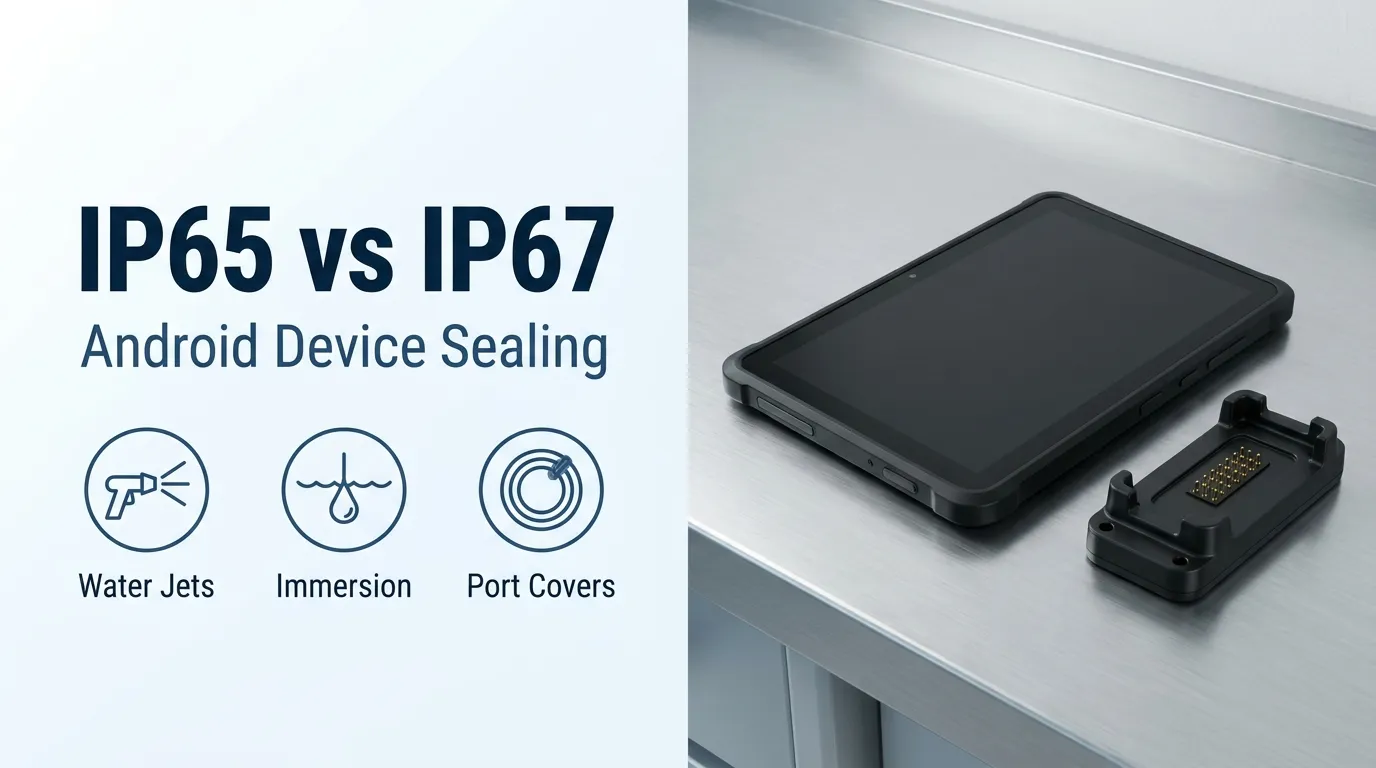
What the dust and water numerals actually test
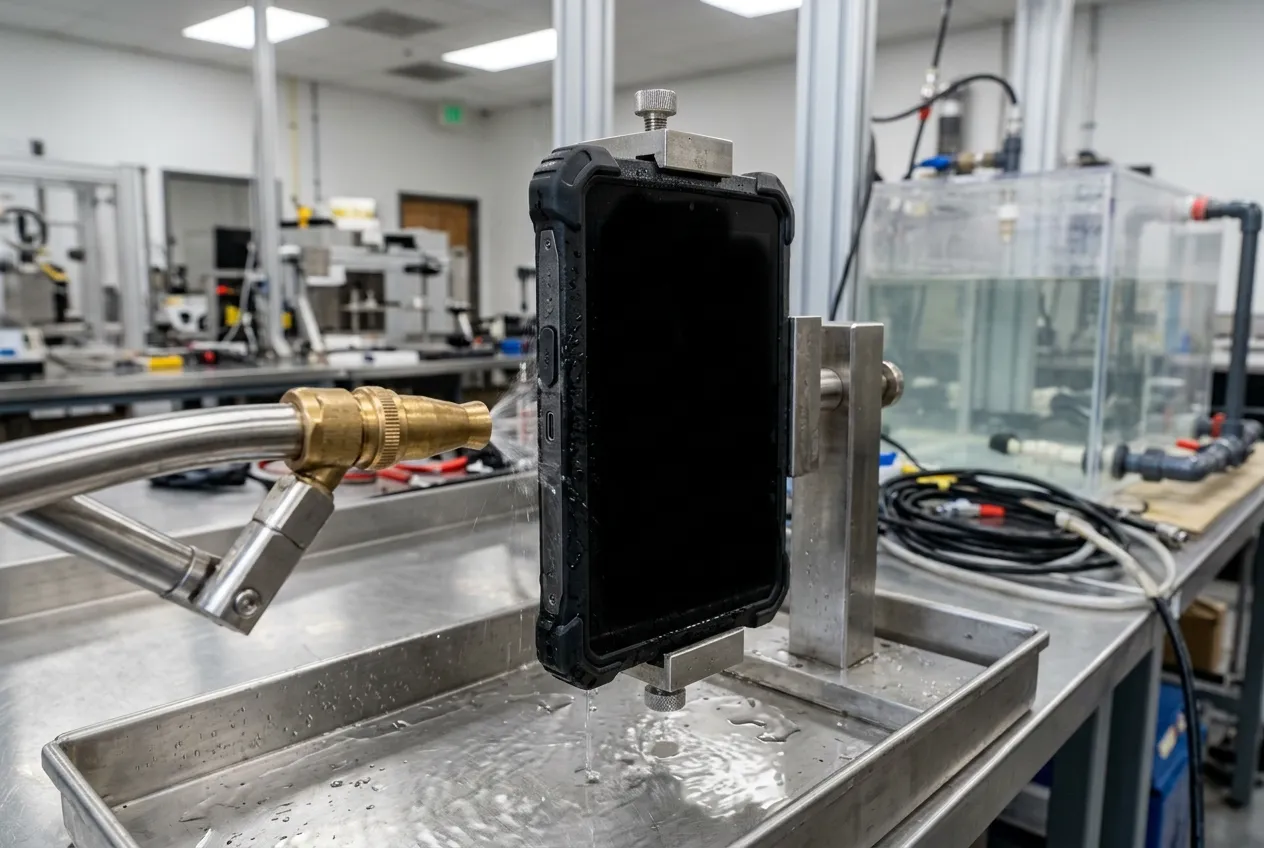
This standard applies to the classification of degrees of protection provided by enclosures for electrical equipment with a rated voltage not exceeding 72,5 kV. In Table 2 of IEC 60529, first characteristic numeral 5 is designated Dust-protected, where ingress of dust is not totally prevented, tested under Clauses 13.4 and 13.5. In Table 2 of IEC 60529, first characteristic numeral 6 is designated Dust-tight with definition No ingress of dust, tested under Clauses 13.4 and 13.6. For first characteristic numerals 4, 5, 6 and additional letter D, the access probe is a test wire 1,0 mm diameter, 100 mm long applied with a test force of 1 N ± 10 %. In the Clause 13.4 dust test for first characteristic numerals 5 and 6, the talcum powder shall pass through a square-meshed sieve with 50 µm nominal wire diameter and 75 µm nominal gap width. In the Clause 13.4 dust test, the amount of talcum powder to be used is 2 kg per cubic metre of the test chamber volume and it shall not have been used for more than 20 tests. Under Clause 13.6.1 test conditions for first characteristic numeral 6, the enclosure shall be deemed category 1, whether reductions in pressure below atmospheric pressure are present or not. For Category 1 enclosures in the dust test, depression draws a volume of air 80 times the sample enclosure volume without exceeding 60 volumes per hour or 2 kPa (20 mbar) on the manometer. In the dust test, if an extraction rate of 40 to 60 volumes per hour is obtained the duration of the test is 2 h. If, with a maximum depression of 2 kPa (20 mbar), the extraction rate is less than 40 volumes per hour, the dust test is continued until 80 volumes have been drawn through, or a period of 8 h has elapsed. Under Clause 13.6.2 acceptance conditions for first characteristic numeral 6, the protection is satisfactory if no deposit of dust is observable inside the enclosure at the end of the test. Water-ingress testing separates nozzle spray from tank immersion. Under Clause 14.2.5 test for second characteristic numeral 5, the internal diameter of the nozzle is 6,3 mm and the delivery rate is 12,5 l/min ± 5 %. Under Clause 14.2.5, the core of the substantial stream is a circle of approximately 40 mm diameter at 2,5 m distance from the nozzle. Under Clause 14.2.5, the test duration per square metre of enclosure surface area likely to be sprayed is 1 min, with a minimum test duration of 3 min, at a distance between 2,5 m and 3 m. Under Clause 14.2.6 test for second characteristic numeral 6, the nozzle internal diameter is 12,5 mm, the delivery rate is 100 l/min ± 5 %, and the minimum test duration is 3 min at 2,5 m to 3 m. For temporary immersion on our rugged Android tablets and rugged handheld phones, under Clause 14.2.7 test for second characteristic numeral 7, the lowest point of enclosures with a height less than 850 mm is located 1 000 mm below the surface of the water. Under Clause 14.2.7 b), the highest point of enclosures with a height equal to or greater than 850 mm is located 150 mm below the surface of the water. Under Clause 14.2.7 c) and d), the water temperature does not differ from that of the equipment by more than 5 K and the duration of the temporary immersion test is 30 min. The 30 min temporary immersion test runs for 10 times the 3 min minimum water-jet test duration. Under Clause 14.2.8 test for second characteristic numeral 8 (continuous immersion), test conditions are subject to agreement between manufacturer and user, but shall be more severe than those prescribed in 14.2.7.
- Under Clause 13.6.1 test conditions for first characteristic numeral 6, the enclosure shall be deemed category 1, whether reductions in pressure below atmospheric pressure are present or not.
- Under Clause 14.2.5 test for second characteristic numeral 5, the internal diameter of the nozzle is 6,3 mm and the delivery rate is 12,5 l/min ± 5 %.
- Under Clause 14.2.7 test for second characteristic numeral 7, the lowest point of enclosures with a height less than 850 mm is located 1 000 mm below the surface of the water.
- Under Clause 14.3 acceptance conditions after testing in accordance with 14.2.1 to 14.2.9, if any water has entered, it shall not be sufficient to interfere with the correct operation of the equipment or impair safety.
| Test method | Nozzle or depth condition | Delivery rate or temperature condition | Duration and distance |
|---|---|---|---|
| Clause 14.2.5 water-jet test for second characteristic numeral 5 | Internal diameter of the nozzle is 6,3 mm; core of stream is approximately 40 mm diameter at 2,5 m distance | Delivery rate is 12,5 l/min ± 5 % | Test duration per square metre is 1 min, minimum test duration of 3 min, at a distance between 2,5 m and 3 m |
| Clause 14.2.6 powerful water-jet test for second characteristic numeral 6 | Nozzle internal diameter is 12,5 mm | Delivery rate is 100 l/min ± 5 % | Minimum test duration is 3 min at 2,5 m to 3 m |
| Clause 14.2.7 temporary immersion test for second characteristic numeral 7 | Lowest point of enclosures with a height less than 850 mm is located 1 000 mm below the surface of the water; highest point for height equal to or greater than 850 mm is 150 mm below the surface | Water temperature does not differ from that of the equipment by more than 5 K | Duration of the temporary immersion test is 30 min |
| Clause 14.2.8 continuous immersion test for second characteristic numeral 8 | Test conditions are subject to agreement between manufacturer and user | Shall be more severe than those prescribed in 14.2.7 | Continuous immersion conditions agreed between manufacturer and user |
Why immersion coding does not automatically cover water jets
Up to and including second characteristic numeral 6, the designation implies compliance also with the requirements for all lower characteristic numerals. An enclosure designated with second characteristic numeral 7 or 8 only is considered unsuitable for exposure to water jets (designated by numeral 5 or 6) and need not comply with numeral 5 or 6 unless multiple coded. In the Clause 6 table, an enclosure that passes both water jets second characteristic numeral 5 and temporary immersion second characteristic numeral 7 is designated IPX5/IPX7 with a Versatile range of application. In the Clause 6 table, an enclosure tested only for temporary immersion numeral 7 without water jets is designated IPX7 with a Restricted range of application. Enclosures for versatile application indicated in the last column shall meet requirements for exposure to both water jets and temporary or continuous immersion. Enclosures for restricted application indicated in the last column are considered suitable only for the conditions to which they were tested. Under Clause 14.2, during the water tests up to IPX6 the water temperature should not differ by more than 5 K from the specimen temperature; if more than 5 K below, a pressure balance shall be provided. When we qualify dual-rated rugged Android handhelds and tablets for washdown and puddle immersion, we specify IEC 60529 Sections 13.4, 13.6.2, 14.2.5, 14.2.7, and 14.3 in the laboratory test plan so both spray and immersion clauses are verified on the same housing revision.
- Up to and including second characteristic numeral 6, the designation implies compliance also with the requirements for all lower characteristic numerals.
- An enclosure designated with second characteristic numeral 7 or 8 only is considered unsuitable for exposure to water jets (designated by numeral 5 or 6) and need not comply with numeral 5 or 6 unless multiple coded.
- In the Clause 6 table, an enclosure that passes both water jets second characteristic numeral 5 and temporary immersion second characteristic numeral 7 is designated IPX5/IPX7 with a Versatile range of application.
- In the Clause 6 table, an enclosure tested only for temporary immersion numeral 7 without water jets is designated IPX7 with a Restricted range of application.
Where Android field devices lose their seal in deployment
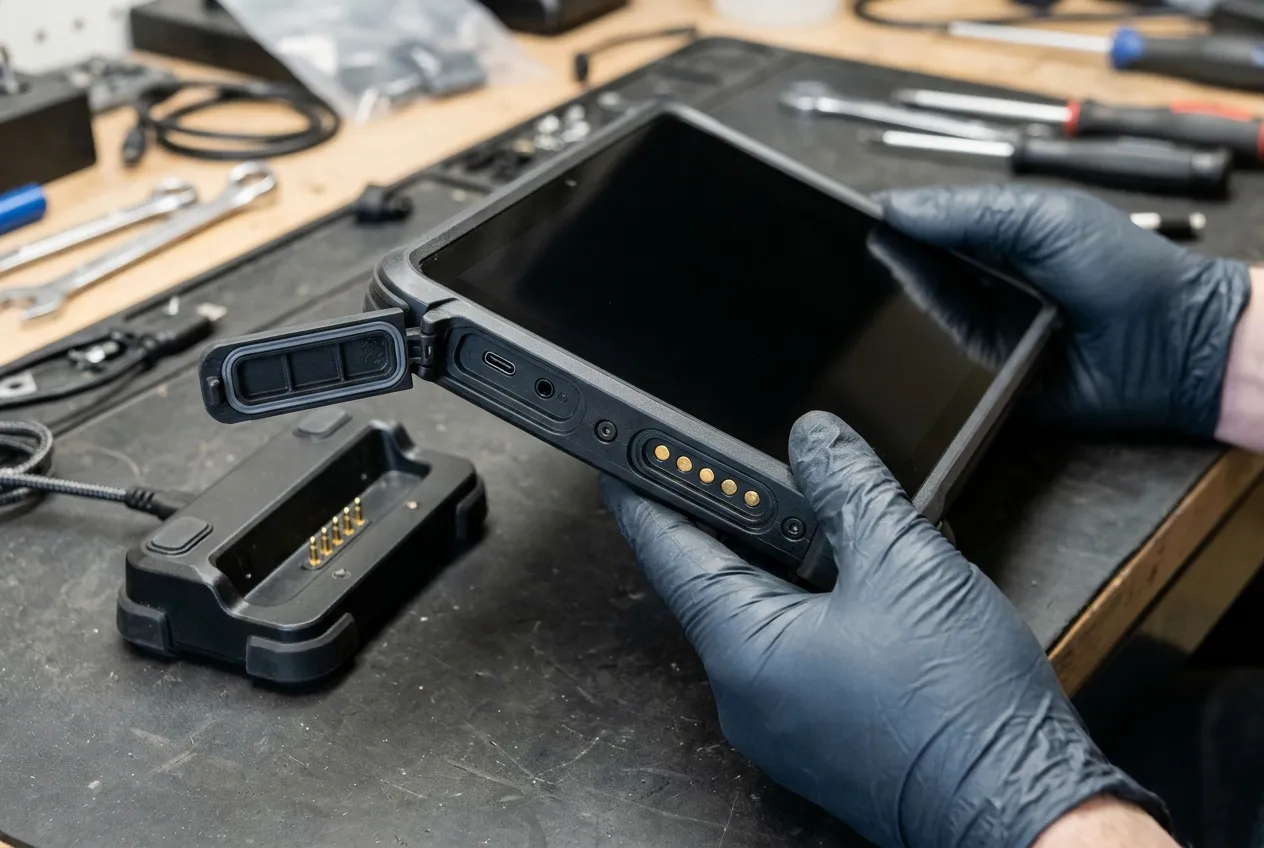
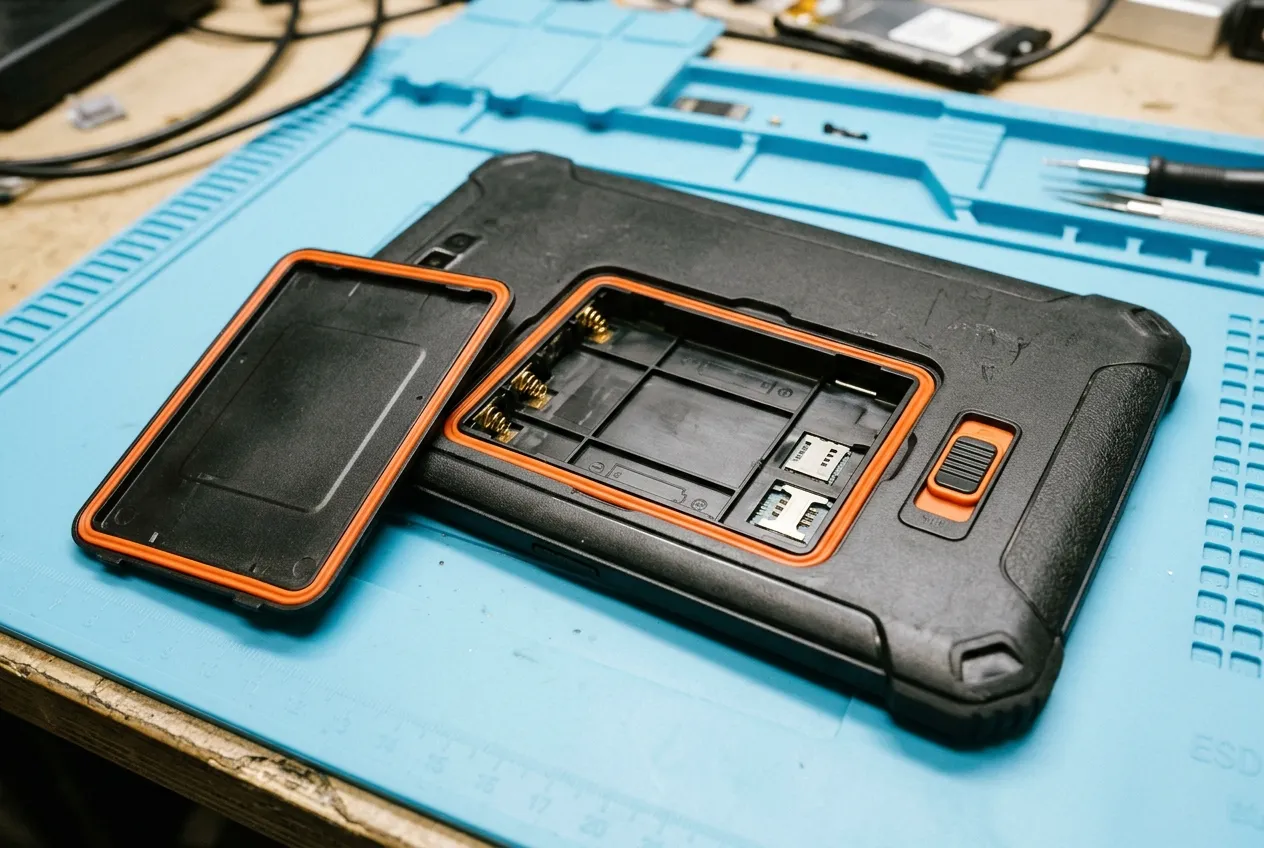
On our rugged Android tablets and rugged handhelds, ingress protection sealing depends on port covers, acoustic vents, battery-bay compression gaskets, and accessory openings, and we confirm it on the exact model revision with the planned dock and cables. When an enterprise tablet uses an exposed pogo-pin docking connector on the bottom edge alongside a hinged elastomer I/O door over the USB-C and nano-SIM bay, the published IP65 or IP67 rating only holds when the elastomer door is fully seated flush with the housing bezel. Removable-battery and hot-swap tablet configurations introduce a second perimeter seal interface. Replacing a nano-SIM card or microSD card inside the battery well requires sliding the mechanical battery-lock latch to the unlock position, lifting the battery cover, and inspecting the perimeter silicone O-ring for dust or nicks. When reinstalling the battery cover, field technicians must insert the tabbed edge into the battery-well slots first and press around the full perimeter until both mechanical latches click shut. Operators must also ensure all battery contacts and elastomer seals are completely dry before inserting a replacement pack, because mating wet battery terminals compromises internal corrosion protection. For heavy outdoor and vehicle-docked deployments, we supply replaceable service parts—including hinged I/O doors, SIM/microSD tray covers, corner bumpers, and battery-bay gaskets—as part of the spare-parts kit so worn elastomer doors can be swapped during preventive maintenance without retiring the terminal.
| Device architecture | Target IEC 60529 sealing scope | Critical port, battery-cover and seal checkpoints |
|---|---|---|
| Pogo-docked rugged Android tablets (warehouse & fleet cradles) | IP65 water-jet sealing (Clause 13.6 + Clause 14.2.5) | Sealed bottom pogo-pin charging/data pad keeps side USB-C elastomer door closed during daily shift charging; verify port-door latch retention after 500 open/close cycles. |
| Field-service rugged Android handhelds & compact tablets | Dual-coded IP65 / IP67 versatile sealing (Clause 14.2.5 + Clause 14.2.7) | Tested for both 6.3 mm nozzle spray (12.5 L/min) and 1 000 mm, 30 min temporary immersion; combines internally sealed USB-C receptacle with secondary elastomer flap. |
| Hot-swap and removable-battery Android tablets | IP65 or IP67 with dual-latch perimeter battery gasket | Tab-and-slot battery cover with mechanical slide lock and replaceable silicone perimeter gasket; operators must keep mating contacts dry during field battery swaps. |
| High-pressure washdown & marine-deck Android terminals | IP66 / IP67 multiple-coded enclosure (Clause 14.2.6 + Clause 14.2.7) | Qualified against 12.5 mm nozzle at 100 L/min plus 1 m immersion; uses screw-locked or cam-latched I/O service covers and hydrophobic ePTFE speaker membranes. |
What to verify in a laboratory test report and sample check
Under Clause 11.1, recommended atmospheric conditions during water or dust tests are temperature range 15 °C to 35 °C, relative humidity 25 % to 75 %, and air pressure 86 kPa to 106 kPa (860 mbar to 1 060 mbar). Under Clause 11.2, the tests specified in the standard are type tests, and test samples for each test shall be in a clean and new condition, with all parts in place and mounted in the manner stated by the manufacturer. Under Clause 14.3 acceptance conditions after testing in accordance with 14.2.1 to 14.2.9, if any water has entered, it shall not be sufficient to interfere with the correct operation of the equipment or impair safety. Through our testing and certification support, our Certificate-to-Model Record maps target-market certification evidence to the exact model, variant, and firmware baseline, and sample validation against the agreed sample acceptance matrix is the gate before production devices are staged.
| Review item | Standard clause or hardware condition | Acceptance verification action |
|---|---|---|
| Atmospheric test conditions | Under Clause 11.1, recommended atmospheric conditions during water or dust tests are temperature range 15 °C to 35 °C, relative humidity 25 % to 75 %, and air pressure 86 kPa to 106 kPa (860 mbar to 1 060 mbar). | Confirm the laboratory report records the ambient temperature, humidity and pressure ranges. |
| Sample state and mounting | Under Clause 11.2, the tests specified in the standard are type tests, and test samples for each test shall be in a clean and new condition, with all parts in place and mounted in the manner stated by the manufacturer. | Sealing depends on port covers, speaker design, and accessory openings, and is confirmed on the exact model revision with the planned dock and cables. |
| Dust-tightness category and acceptance | Under Clause 13.6.1 test conditions for first characteristic numeral 6, the enclosure shall be deemed category 1; under Clause 13.6.2, the protection is satisfactory if no deposit of dust is observable inside the enclosure at the end of the test. | Check that Category 1 depression drew 80 times the sample volume without exceeding 60 volumes per hour or 2 kPa (20 mbar). |
| Water-entry acceptance criteria | Under Clause 14.3 acceptance conditions after testing in accordance with 14.2.1 to 14.2.9, if any water has entered, it shall not be sufficient to interfere with the correct operation of the equipment or impair safety. | Inspect internal compartments, battery contacts and port doors after exposure. |
| Model-to-certificate traceability | The Certificate-to-Model Record maps target-market certification evidence to the exact model, variant, and firmware baseline. | Sample validation against the agreed acceptance matrix should be the gate before production devices are staged. |
Select the sealing scope for your Android device rollout
Across our rugged tablets and rugged handhelds, ingress protection sealing depends on port covers, speaker design, and accessory openings, and we confirm it on the exact model revision with your planned dock and cables. Combine sealing verification with our environmental method selection guide when drops or vibration accompany wet field work. For a field-device sealing review, send your project requirements with the proposed device and accessories, the spray or immersion exposure scenario, the charging dock or cable plan, and the laboratory report scope.
| Field exposure scenario | Enclosure designation rule | Hardware and operational check |
|---|---|---|
| Directional water spray and washdown without tank immersion | Under Clause 14.2.5 test for second characteristic numeral 5, the internal diameter of the nozzle is 6,3 mm and the delivery rate is 12,5 l/min ± 5 %; Clause 14.2.6 uses a 12,5 mm nozzle at 100 l/min ± 5 %. | Confirm whether port covers remain closed or whether a pogo-pin docking connector is used during shift charging. |
| Temporary immersion in standing water without high-velocity water jets | In the Clause 6 table, an enclosure tested only for temporary immersion numeral 7 without water jets is designated IPX7 with a Restricted range of application. | Enclosures for restricted application indicated in the last column are considered suitable only for the conditions to which they were tested. |
| Combined water-jet spray and temporary immersion in field service | In the Clause 6 table, an enclosure that passes both water jets second characteristic numeral 5 and temporary immersion second characteristic numeral 7 is designated IPX5/IPX7 with a Versatile range of application. | Enclosures for versatile application indicated in the last column shall meet requirements for exposure to both water jets and temporary or continuous immersion. |
| Field battery swap or SIM and microSD servicing | Ensure all battery contacts and elastomer gaskets are dry prior to placing the battery in the terminal so wet mating surfaces do not corrode internal pins. | Verify that operators seat the tabbed end of the battery cover into the slots in the battery well and slide the mechanical security lock to the locked position after servicing SIM or microSD trays. |
Sources
Clause numbers, test parameters, and verification workflows in this guide reference the following standards and Vantora programme documentation:
- ANSI/IEC 60529 NEMA extract, Clause 1: classification of degrees of protection provided by enclosures for electrical equipment with a rated voltage not exceeding 72,5 kV.
- IEC 60529 consolidated edition and amendment: Clause 5.2 Table 2, Clause 6, Clause 11.1, Clause 11.2, Clause 12.1 Table 6, Clause 13.4, Clause 13.5, Clause 13.6, Clause 13.6.1, Clause 13.6.2, Clause 14.2, Clause 14.2.1 to 14.2.9, Clause 14.2.5, Clause 14.2.6, Clause 14.2.7, Clause 14.2.8, and Clause 14.3.
- Vantora programme documentation: Rugged Android Tablets, Rugged Android Phones, Testing and Certification Support, and Sample Acceptance Matrix.
Preguntas frecuentes
Does an immersion rating automatically include water-jet protection?
No. An enclosure designated with second characteristic numeral 7 or 8 only is considered unsuitable for exposure to water jets (designated by numeral 5 or 6) and need not comply with numeral 5 or 6 unless multiple coded. In the Clause 6 table, an enclosure that passes both water jets second characteristic numeral 5 and temporary immersion second characteristic numeral 7 is designated IPX5/IPX7 with a Versatile range of application.
What are the nozzle and tank test parameters for numeral 5 versus numeral 7?
Under Clause 14.2.5 test for second characteristic numeral 5, the internal diameter of the nozzle is 6,3 mm and the delivery rate is 12,5 l/min ± 5 %, with a test duration per square metre of 1 min and a minimum test duration of 3 min at a distance between 2,5 m and 3 m. Under Clause 14.2.7 test for second characteristic numeral 7, the lowest point of enclosures with a height less than 850 mm is located 1 000 mm below the surface of the water (or the highest point is 150 mm below the surface for height equal to or greater than 850 mm) for a duration of 30 min with water temperature within 5 K of the equipment.
How do port covers, docking connectors and battery locks affect Android tablet sealing?
Across our rugged Android tablets and handhelds, ingress protection sealing depends on port covers, speaker design, and accessory openings, and we confirm it on the exact model revision with the planned dock and cables. Using bottom pogo-pin docking contacts for daily charging keeps hinged USB-C elastomer doors closed and reduces wear on the perimeter port seal.
What precautions apply when replacing batteries or SIM trays on sealed Android devices?
Operators must ensure all battery compartments and elastomer seals are dry prior to placing a replacement battery in the device so moisture is not trapped against internal contacts. When reinstalling a tabbed battery cover, insert the tabbed edge into the battery-well slots first, press down around the perimeter gasket, and engage the mechanical lock switch fully.