| Profile | Typical use | Validation focus |
|---|---|---|
| Education and community tablet | Training, approved content, assessment, field learning and controlled access | Content app, offline behavior, allowlist, charging and account reset flow. |
| Field inspection tablet | Forms, photos, maps, checklists, asset review and supervisor approval | Camera, GPS, sunlight readability, case, battery and sync failure recovery. |
| Kiosk tablet | Check-in, ordering, visitor flow, self-service or display mode | Launcher/kiosk state, mount, power, restart, screen timeout and exit path. |
| Partner-branded tablet | White-label software bundle, partner delivery and app-led device offer | Branding, app preload, packaging, responsibility matrix and support handoff. |
Custom Android Tablets for Branded, App-Ready Rollouts
A custom Android tablet program turns a proven OEM tablet platform into your device — branded, app-ready and policy-controlled — with hardware, accessories, app state and management policy validated together before a batch is staged.
Diperbarui
Brief: define the tablet program before choosing a model
A custom Android tablet program should start with the operating rules, not with a catalogue model. A tablet can look right on a spec sheet and still fail in deployment because charging, cases, mounts, camera angle, account flow, offline behavior or kiosk exit paths were never tested — programs fail at the edges, not at the center. Before any model shortlist exists, Vantora maps who will use the tablet, which application must run, whether Google services are required or explicitly unwanted, which regions and certification assumptions apply, how the device is mounted, carried and charged, what the packaging must say and which controls must survive a factory reset. The brief also records the quantity band, reorder expectation, accessory list and the support boundary between the buyer, Vantora and any management platform. The Android device project requirements checklist turns those questions into a fillable document, and the 20-question feasibility review is the fastest way to surface the assumptions a quotation would otherwise hide. For agencies and software companies buying on behalf of an end customer, the brief can be redacted: the project is described by workflow, region and volume band while the end-customer name stays out of the document.
Common tablet rollout profiles
Most custom tablet briefs arrive as one of four profiles, and naming the profile early keeps the validation plan honest, because each profile fails at a different edge. Each profile also has a deeper home elsewhere on this site: workflow-level scoping for inspection work lives in field inspection tablets, the program structure for schools and NGOs lives in education and community device programs, locked single-app deployments are scoped in dedicated kiosk devices, and when the environment is the main risk the hardware conversation moves to rugged tablets. This page owns the layer all of those share: how a proven OEM tablet platform becomes your branded, app-ready, policy-controlled device.
Specification ranges to confirm
Custom tablet programs are configured from proven OEM Android tablet platforms rather than designed from zero, so the practical scoping question is which specification ranges are realistic, not what can be imagined. The table below shows typical planning ranges; every figure is subject to model availability, OEM roadmap and project validation, and the final specification is fixed only on the accepted, versioned sample. Writing the requirement into a structured document is what makes quotations comparable — the Android device build spec guide shows how each row becomes a testable line. Accessories deserve the same discipline: cases, docks, charging carts, straps and mounts are part of the device decision rather than an afterthought, and that layer is catalogued in accessories, docks and chargers.
| Area | Typical range or decision | Why it matters |
|---|---|---|
| Display | Confirm display size on the selected model, including for retail POS tablets. This page does not publish an inch band. | A larger screen helps forms and training but changes weight, mount and cost. |
| Battery | Confirm capacity on the selected model during sample validation. This page does not publish a mAh figure for a named device. | Runtime must be tested with the real app, radios and screen brightness. |
| Durability | Consumer, semi-rugged or rugged housing path | Cases, drops, dust, water and cleaning assumptions affect model choice. |
| Connectivity | Wi-Fi only, LTE/5G, GPS, NFC or scanner accessory | Target market and certification assumptions may change the shortlist. |
GMS, EDLA or AOSP: settle the platform path early
The Google-services decision gates everything downstream — app compatibility, account flow, update path and enrollment method — so it belongs in the brief, not in the sample review. A GMS build suits tablets whose apps depend on Google Play services, managed Google Play distribution or Google account sign-in; a services-free AOSP build is the separate system path when the app set is closed and privately distributed. Managed Google Play is not that path: it is an organization Google Play service and requires Google registration. The trade-offs, provisioning consequences and evidence to demand for each path are compared in GMS vs AOSP for enterprise devices. Tablet buyers also meet a third label: EDLA, which OEM marketing attaches to some enterprise tablets and interactive displays. EDLA is not a third operating system — public materials describe it as a licensing route into the GMS layer for certain enterprise device categories, and the label proves nothing about a specific model without evidence. What EDLA does and does not establish, and the model-level questions to ask when a supplier invokes it, are covered in EDLA vs GMS vs AOSP. Whichever path is chosen, it is validated on the exact model and build during sample acceptance, because Google-services status is a per-model, per-build fact, not a brand attribute.
Send a redacted brief. We reply within 1 business day.
Branding levels: from packaging identity to firmware identity
Branding a tablet is a ladder, not a single decision, and each rung changes the MOQ sensitivity, tooling need and validation depth of the program. A packaging-level program touches artwork and kitting and can move quickly; a firmware-level identity program needs OEM cooperation, longer validation and stricter version control, because its changes live below the factory-reset line. Most tablet programs combine a cosmetic level with a software-identity level: a logo on the housing, a branded boot experience, a preloaded app set and a locked launcher. The discipline that keeps quotations comparable is naming the level explicitly in the brief, so the quote, the sample plan and the acceptance matrix all describe the same program.
| Branding level | What changes | Typical dependency |
|---|---|---|
| Level 1 — Packaging and accessories | Box, inserts, quick-start card, labels, charger and case presentation | Artwork approval and print lead time; lowest MOQ sensitivity of the four levels. |
| Level 2 — Device cosmetic | Logo print or engraving, housing color and finish options | Model- and quantity-dependent; some housings accept a logo only, others allow wider changes. |
| Level 3 — Software identity | Boot animation, wallpaper, launcher defaults, preloaded apps and default settings | Requires firmware or configuration access; scope is OEM- and platform-dependent. |
| Level 4 — Firmware-level identity | System-level device naming, locked configuration and settings that survive factory reset | Deepest level; needs OEM cooperation, longer validation and strict sample version control. |
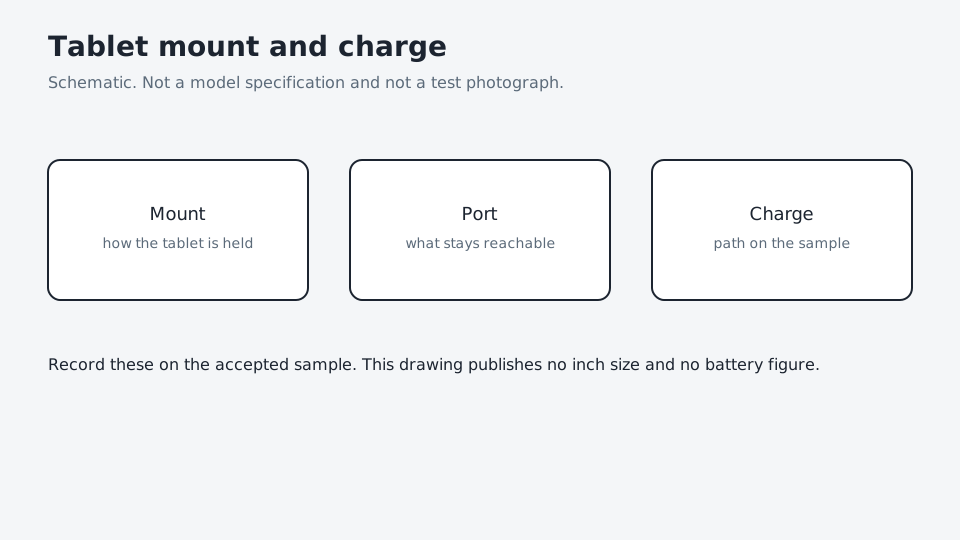
Takeaway. Confirm mount, port, and charge path on the sample. The schematic is not a model specification.
Validate: the tablet acceptance matrix
A tablet sample is only useful when it is versioned and tested against the real deployment, not admired on a desk. The acceptance matrix should cover more than a visual review: app launch, permissions, account state, offline mode, sync recovery, camera or scanner behavior, kiosk or launcher state, charging path, accessory fit, packaging, labels and support handoff — with every row naming the expected result and the person who accepts it. Mount and charging edges deserve particular attention on tablets, because a device that passes every software test can still fail on a wall bracket that blocks the port or a charging cart that trips a battery-care limit. The completed record — pass, fail and conditional — becomes the contract between the sample everyone approved and the batch that follows it.
- App launch, sign-in, permission and update-path checks on the exact target build
- GMS, managed-configuration or AOSP dependency confirmed before approval
- Kiosk, launcher and factory-reset behavior under realistic conditions
- Charging path, dock or cart fit, and battery behavior over a full usage day
- Camera, scanner, GPS and sensor checks where the app depends on them
- Sample version record: firmware build, app versions and configuration state
Stage: from accepted sample to staged tablet batch
Once the tablet sample is accepted, the production batch is staged against the same recorded build state, so the receiving team unboxes devices that are already in a known condition instead of a pallet of boxes someone still has to configure. Staging can include app preload, enrollment preparation, asset labels, serial records, accessory kitting, packaging and carton notes. How preload stays consistent across hundreds of units is covered in preloading apps on Android devices at scale, and the full staging discipline — what a batch record contains and why it matters at handoff — is described in batch-staged Android devices before delivery. The batch record also lists known limitations, which makes reorder and support work easier because the deployed baseline stays visible long after the boxes are gone.
Quantities, lead times and reorders
Custom tablet programs quote from around 500 units upward. Below that floor, the engineering, sampling and staging effort does not amortize, and a stock tablet with an MDM subscription is usually the more honest recommendation. Above it, cost and lead time scale with customization depth rather than with the logo: packaging- and configuration-level programs move fastest, with samples typically available within one to three weeks after the configuration freeze, while cosmetic housing work and firmware-level identity typically require higher quantities and add OEM build cycles before the first sample exists. All of these are planning figures, not commitments — the full breakdown, including sample costs and what moves each number, is in MOQ, cost and timeline for custom Android devices, and the delivery sequence from brief to staged batches is walked in order in the development process. The rule that protects a reorder six months later is the same one that protects the first batch: nothing ships that was not built to the accepted, versioned sample record, and any unavoidable component or firmware change between batches is surfaced, re-tested against the matrix and recorded rather than absorbed silently.
What to send us
| Item | Why we need it | Example format |
|---|---|---|
| App package and version | The sample has to match the build you intend to ship | Package name and version code |
| Google services and distribution | The system path and the app-distribution path are separate decisions | GMS or services-free AOSP, then managed Google Play, preload, or another channel |
| Mount and power | A device that passes the app test can still fail at the dock or the vehicle feed | Vehicle or fixture, ignition or dock power, and which ports must stay free |
| Market and radio | Region fit is checked per market, not assumed from the model name | Country and carrier or band notes |
| Quantity and reorder | A planning band is not a delivery guarantee | A range, and whether you expect a reorder |
Send a redacted brief. We reply within 1 business day.
Pertanyaan Umum
Can Vantora provide custom Android tablets for education programs?
Yes, subject to model fit, app readiness and policy requirements. Education and community tablet programs usually need content control, account flow, charging, packaging and support handoff validated early.
Can tablets be locked to one app?
Often yes through a dedicated device, kiosk, launcher or MDM/EMM path, but the exact lock behavior depends on the selected model, Android build and management stack.
Can rugged Android tablets be included?
Yes. Rugged or semi-rugged paths can be scoped when the field environment requires stronger housing, better sunlight readability, accessories or battery capacity.
Do you support tablet accessories?
Accessories such as cases, straps, chargers, docks, mounts and scanners can be included when compatible with the selected model and validated with the sample.
What is the first step?
Send the app/workflow, user environment, target market, quantity band, accessory needs, control rules and any packaging or partner-branding assumptions.
What is a typical MOQ for a custom Android tablet program?
Programs typically quote from around 500 units. Packaging- and configuration-level work sits at the lower end, while cosmetic housing changes and firmware-level identity typically require higher quantities. The actual MOQ is model- and OEM-dependent and is confirmed in the feasibility review.
How long does a tablet sample take?
Configuration-level samples are typically available within one to three weeks after the configuration freeze. Firmware-level samples take longer because OEM build cycles are involved. Both figures are typical and depend on model, OEM scheduling and customization depth.
Should the tablets be a GMS or an AOSP build?
Choose the system path from the app stack: GMS when apps depend on Google services, or a services-free AOSP build when they do not. Managed Google Play is an organization Google Play service that requires Google registration, not a Google-independent path. If a supplier mentions EDLA, treat it as a claim about GMS licensing for certain enterprise device categories that needs model-level evidence, not as a third option.
Ceritakan alur kerja dan aturan Anda.
Kami mengubah persyaratan menjadi perangkat yang siap diterapkan.