Custom Android Device Program for a Middle East Faith-Based Organization
How we translated a community organization’s app, identity and content-access requirements into a branded, focus-oriented Android tablet experience — anonymized, with each feature stated subject to technical validation.
Diperbarui
Project Context
The client is a faith-based community organization in the Middle East serving its members and families through a content and learning program. They approached us with a software-and-content vision and asked whether it could arrive as a coherent, branded tablet experience rather than a generic Android device with an app installed afterward. To respect confidentiality, this account uses regional and organization-type descriptors only — no names, logos or device brands — and focuses on the user experience the program was meant to deliver. The build layers behind that experience — branding, app preload and management policy — are defined in what is a custom Android device, and the hardware side is covered in custom Android tablets.
The Requirement
- Carry the organization’s identity on the device itself, not just inside an app
- Preinstall the organization’s dedicated apps and make content access the default first-run experience
- Provide a focus-oriented experience that keeps members on program content and limits distraction
- Support family use with a simpler profile suitable for children
- Respect member privacy and keep the experience consistent across the fleet
- Confirm which requested behaviors were feasible, and at what development effort, before committing
What We Delivered
| Item | Status on this page | Not claimed |
|---|---|---|
| Requirement | Defined in the redacted matrix | No unpublished quantity |
| Feasibility | Answered item by item | Not a production approval |
| Prototype | Reviewed on a device | Not a delivered batch |
Constraints & Dependencies
- Several requested behaviors are OEM- and platform-dependent — what a launcher, app-lock or boot screen can do varies by device and management stack
- Brand and experience features were specified as configurable for MDM/EMM and dedicated-device modes, not as guarantees on arbitrary hardware
- The assistant feature was kept deliberately subordinate — a convenience layer gated behind validation, never the core of the program
- Privacy expectations shaped what data the experience would touch and what could be centrally managed versus left on-device
Validation & Acceptance
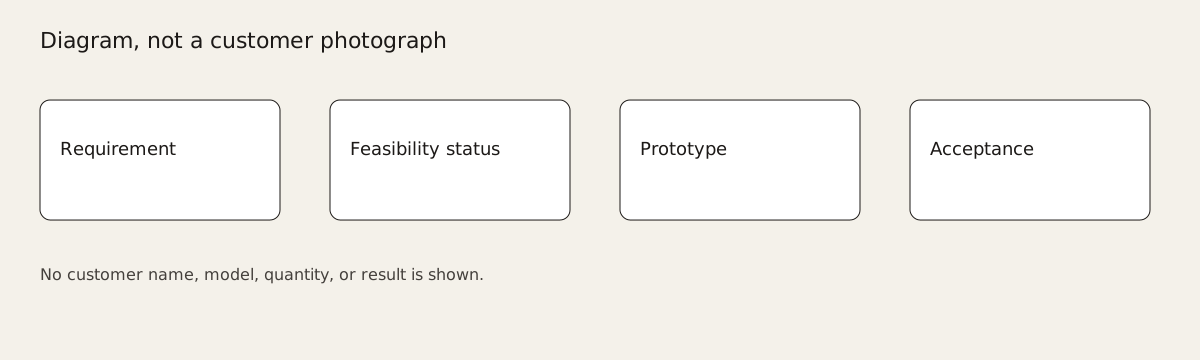
- Captured the organization’s wishlist as a redacted requirement matrix mapping each desired behavior to a concrete device-level capability
- Returned an R&D feasibility response marking each item as supported, conditional or needing development, with effort estimates
- Built a prototype against the agreed specification so the experience could be reviewed on a real device
- Defined test scenarios and acceptance criteria, then iterated through revisions before any view on bulk production
Send a redacted brief. We reply within 1 business day.
What This Project Demonstrated
- Demonstrated vertical experience integration: an organization’s identity, apps and content access translated into the device’s default experience
- Showed our app-to-device translation method — turning a software-and-content wishlist into a buildable, testable device specification
- Proved we can coordinate brand, application and experience layers for an organization deployment under confidentiality
- Established a requirement-matrix-to-prototype workflow that transfers to other community, education and content-platform programs
What to send us
| Item | Why we need it | Example format |
|---|---|---|
| Application | The case starts from the organization’s app | App name and version, redacted |
| Content access rules | The experience is defined by what members may open | Allowed and blocked content classes |
| Identity artwork | Brand work needs the mark, not the customer name | Logo file, or a description |
| Family-use limits | A child profile was a concept, so the limit has to be explicit | What a simpler profile may and may not do |
| Redacted format | The memo hides the organization | See the redacted feasibility memo |
Send a redacted brief. We reply within 1 business day.
Pertanyaan Umum
Is the client named in this case study?
No. The organization is described only by region and type — a Middle East faith-based community organization — with no names, logos or device brands. Identifying detail is published only with written permission.
Were all the requested features delivered as-is?
No. Each item from the wishlist was returned with a feasibility status — supported, conditional or needing development — and an effort estimate. Every feature is stated subject to technical validation and is OEM- and platform-dependent.
Was the assistant feature central to the program?
No. The assistant was a subordinate convenience layer gated behind validation. The core value was the branded, focus-oriented experience and reliable content access, not an AI feature.
Can a similar experience be built for another community or content organization?
The requirement-matrix-to-prototype workflow transfers to other community, education and content-platform programs, though the specific behaviors remain subject to device, OEM and management-stack validation.
Discuss a Similar Organization Program
End-customer names and commercial information are not required for an initial feasibility review.