Custom Android Device Testing and Certification Support
Validate the sample before production: app behavior, policy controls, hardware options, connectivity, packaging, ruggedness assumptions and target-market certification inputs.
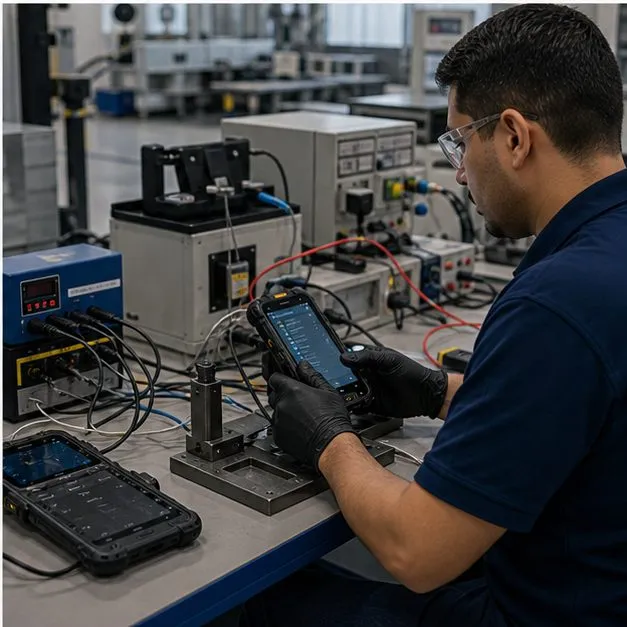
Testing is the gate between sample and batch
A validated rollout should not move to production because a demo looked good. It should move because the selected sample passes agreed acceptance criteria. Vantora turns requirements into test rows covering hardware, software, network, management policy, accessories, packaging and known limitations.
Acceptance matrix categories
| Category | Examples | Evidence produced |
|---|---|---|
| App behavior | Launch, login, permissions, offline mode, sync and update path | App and Permission Map test results |
| Policy controls | Kiosk, allowlist, remote command, reset path and support exception | Management Policy Map results |
| Hardware options | Scanner, RFID, camera, battery, dock and accessory fit | Hardware validation table |
| Connectivity | LTE bands, Wi-Fi, Bluetooth, NFC, GNSS and SIM/APN assumptions | Connectivity test notes |
| Packaging and kitting | Label, carton, manual, charger, cable, case and serial record | Batch staging checklist |
| Known limits | OEM, Android, MDM, app or target-market dependency | Known Limitations Library entry |
Certification support is model and market specific
Certification support should be scoped by model, target country and shipment path. CE, FCC or other country requirements are not generic page-level promises. The certification record should map a certificate or test document to the exact model, variant, firmware baseline and target market where it applies. The country-by-country series sits under device programs across the GCC and Latin America, and the sample-side evidence is templated in the sample acceptance matrix.
Testing common device classes
A rugged tablet test plan differs from a kiosk tablet or a barcode handheld. Vantora adapts the matrix to the device class: scan performance for handheld computers, mount and charge behavior for tablets, kiosk escape paths for dedicated devices, and policy behavior for controlled-use phones.
From pass/fail to production approval
The test result should create a clear decision: pass, fail, conditional pass or accepted limitation. Conditional items are recorded before production so the buyer, partner and app team know what is being accepted. This is the practical proof layer behind the phrase rollout-validated.
A pass/fail matrix for app, policy, hardware, connectivity, packaging and known limitations.
Maps target-market certification evidence to exact model, variant and firmware baseline.
FAQ
Do you validate a sample before bulk production?
Yes. Sample validation against the agreed acceptance matrix should be the gate before production devices are staged.
Can Vantora guarantee certification for a country?
No. Certification depends on the model, variant, target market, test body and documentation. Vantora can coordinate inputs and map evidence to the selected device.
What does a conditional pass mean?
It means the project accepts a known limitation or dependency before production. The item should be recorded in the release note and known limitations list.
Can ruggedness be tested?
Ruggedness assumptions such as IP rating, drop, temperature, vibration or mount behavior can be reviewed against model evidence and project-specific checks.
Who signs off the test matrix?
The project owner or designated reviewer should accept the sample. Vantora can run and document the test, but acceptance authority should be named in the brief.
Tell us your workflow and rules.
We turn requirements into deployment-ready devices.