Android Device Provisioning and Batch Staging
Stage Android devices against the accepted sample: app package, policy, enrollment, SIM/APN, labels, accessories, packaging and serial records before delivery.
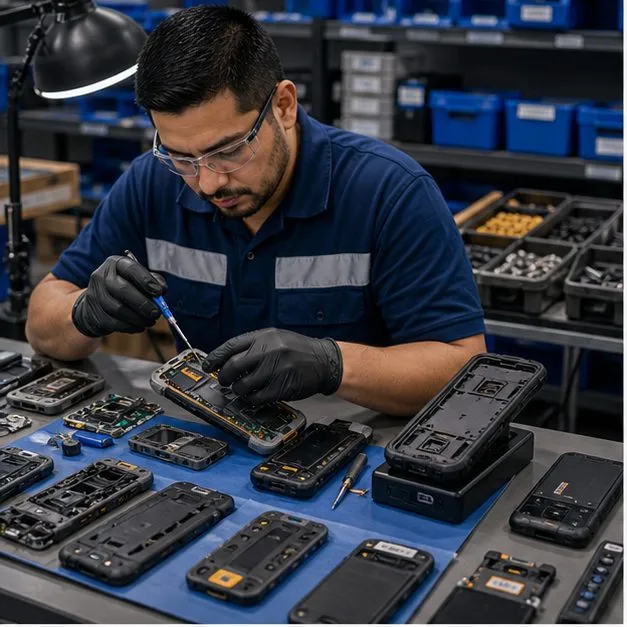
Provisioning turns a sample into a repeatable batch
Provisioning is the Stage step of a validated rollout. The accepted sample defines what each production device should receive. Batch staging applies that build consistently and records the device identifiers, app version, policy version, packaging and kitting state so the rollout can be audited after delivery.
Provisioning record fields
| Field | Why it matters | Example |
|---|---|---|
| Serial or IMEI range | Connects shipped units to the accepted batch | Carton 1: serial range or IMEI list |
| Firmware and Android version | Confirms batch baseline | Accepted build and release note version |
| App package and version | Shows what app state shipped | APK name, version and source |
| Enrollment and policy | Connects devices to the management profile | Tenant, profile, policy version and enrollment method |
| SIM/APN or network profile | Supports field activation | SIM state, APN profile or Wi-Fi profile |
| Accessory and packaging kit | Prevents site-by-site mismatch | Case, dock, cable, label, manual and carton contents |
Enrollment and app preload
The provisioning plan can include app preload, managed app delivery, QR enrollment, zero-touch enrollment, device-owner setup, MDM or EMM profile, kiosk or launcher state, Wi-Fi profile and SIM/APN configuration. The selected method depends on the device, target country, management stack and privacy requirements. The methods themselves — zero-touch, QR, NFC, EMM token and OEM routes — are compared in Android device provisioning methods.
Labels, kitting and site distribution
Rollouts often fail at the packaging layer. A good staging plan names asset labels, site labels, manuals, accessories, chargers, cables, spare batteries, SIMs, carton layout and whether devices are grouped by site, user role or partner. These details should be validated on a pilot carton before the full batch is packed.
Handoff after staging
The handoff should include the batch record, known limitations, support contact, warranty path and any activation steps the receiving team must perform. The goal is not only ready-to-use devices, but a batch that can be supported and reordered with a known baseline.
A staging record for serial range, firmware, app, policy, labels, accessories and carton state.
FAQ
Can devices ship ready for field use?
They can ship staged against the accepted sample, including app, policy, enrollment, labels and accessory kit, subject to the selected device and management path.
Do you provide serial or IMEI records?
Yes. Batch records can include serial or IMEI ranges, firmware baseline, app version, policy version and carton grouping.
Can SIM and APN setup be included?
SIM, APN and network profile setup can be scoped where the target carrier, region and device path support it.
Can devices be packed by site or user group?
Yes. Kitting can be organized by site, role, carton, label or partner delivery structure when that information is provided before staging.
What is the most important output of provisioning?
The batch record is the most important output because it ties shipped devices back to the accepted sample and support baseline.
Tell us your workflow and rules.
We turn requirements into deployment-ready devices.