TDRA Type Approval Guide for Android Devices in the UAE
UAE certification planning guide for Android phones, tablets and connected devices. Last checked against official sources on 2026-07-03; confirm the final path with the authority, local applicant, lab or importer before shipment.
- Published
- Updated
What makes the UAE path unusually explicit
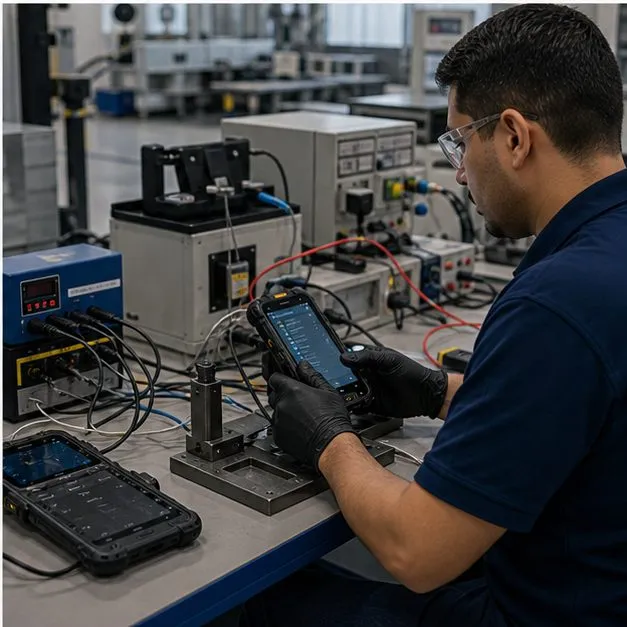
The UAE is one of the few markets in this series where the regulator publishes explicit per-level service times and fees for type approval: TDRA’s register-and-approve service describes severity levels with stated working-day targets and listed fees. That transparency cuts both ways — schedules become predictable once the severity level is agreed, but a wrong severity assumption or an incomplete filing resets the clock. Registration also connects directly to commercial reality: telecom equipment must be registered before use, sale or distribution, and certificate, supplier registration and importer authorization all meet at customs release. Where the same model has to clear more than one Gulf market, the program view sits in device programs across the GCC.
What this guide is and is not
This guide helps buyers prepare a device brief before formal approval work begins. It is not legal advice, not an authority filing and not a promise of approval. The useful output is a model-to-market evidence pack: exact model, radios, test reports, certificate holder, importer role, labels, manuals and known limitations.
TDRA official checkpoint
The entry point reviewed for this guide is the TDRA register-and-approve service, which sets out application steps, severity levels, expected times and the fee schedule. Read it together with the current Type Approval Policy for certificate validity, delegation, laboratory acceptance and customs release rules — and treat the live service page, not this guide, as authoritative for figures.
| Official checkpoint | What to verify | Why it matters |
|---|---|---|
| Register and approve service | Severity level, application steps, expected time and fee schedule | TDRA levels affect review time and inspection assumptions. |
| Type Approval overview | Confirmation that RTTE must be registered before use, sale or distribution in the UAE | Defines the commercial market-entry requirement. |
| Type Approval Policy V4 | Certificate validity, delegation, lab acceptance and customs release rules | Connects certificate holder, importer and shipment release responsibilities. |
TDRA register and approve telecom equipment process map
The UAE sequence starts with a severity-level determination, because level drives review time, inspection likelihood and sample assumptions. The rows below map the typical path from level determination through technical file, portal submission and customs release.
| Step | Evidence to prepare | Vantora support |
|---|---|---|
| Determine risk/severity level | Device category, radios, inspection need and target use | Record Level 1/2/3 assumption and open inspection risk. |
| Prepare technical file | Application data, test reports, photos, model identity and supplier registration status | Create build spec and known limitations record. |
| Submit and pay fees | UAE Pass/service portal, required documents and fee checkpoints | Align project timeline with TDRA review and certificate issuance steps. |
| Customs and market release | Certificate holder, importer authorization and shipment-specific release need | Map certificate-to-model and importer role before batch shipment. |
Spectrum and network considerations
UAE operators were among the earlier 5G movers globally, and both 4G and 5G coverage is extensive in populated areas. For device programs that shifts the risk from coverage to configuration: confirm the exact radio variant’s band support and any carrier-specific requirements for the intended service, especially when devices are sourced as global variants. Confirm current spectrum and approval status through TDRA and validate connectivity expectations with the target operator during sample acceptance rather than after batch staging.
Planning ranges and cost checkpoints
The planning table keeps TDRA’s published checkpoints next to the assumptions a buyer must still confirm. Authority-side figures are the ones stated on the service page at review time; laboratory, inspection, representative and logistics costs sit outside them and are project-specific.
| Planning item | Typical assumption to confirm | Risk if missed |
|---|---|---|
| Authority time | TDRA service page lists Level 1: 1 working day, Level 2: 5 working days, Level 3: 10 working days after complete filing | Wrong severity assumption can shift schedule and sample needs. |
| Authority fees | TDRA service page lists transaction review AED 500 and certificate issuance AED 200; inspection fees vary by test type | Budget must include inspection when TDRA requests it or the customer opts in. |
| Certificate and importer role | Confirm registered supplier, certificate holder, delegation and customs release path | A device may be approved but still need correct importer authorization for shipment. |
How Vantora prepares the device packet
Vantora does not replace the local applicant, authority, importer or accredited lab. We help prepare the build evidence those parties need: model/variant, radio list, OS and firmware note, app and policy state, photos, label/packaging assumptions, sample acceptance result and known limitations. The same packet feeds market-specific testing, customs or shipment release review. The capability behind it, including how test houses, certificate holders and importer roles are coordinated, is described in testing and certification.
The rest of the certification series
Device programs rarely stop at one market, and the sequencing between markets is usually what decides the schedule: approvals that can run in parallel, evidence that can be reused across filings, and the one market whose lead time sets the shipment date. The companion guides cover ANATEL homologation in Brazil, CRT homologation in Mexico, CST and SASO approval in Saudi Arabia, NTRA type approval in Egypt, SDPPI certification in Indonesia. Read them together when a single build is destined for more than one market — the model identity, radio list, label artwork and test reports are largely shared inputs, while the applicant, certificate holder and local representative are usually not, and it is the second set that determines who can file at all. Where the same build serves several markets, record the union of their requirements in the device build spec and keep unresolved market questions in the known limitations library rather than resolving them optimistically at quotation time.
| Market | Authority | Guide |
|---|---|---|
| Brazil | ANATEL | ANATEL homologation in Brazil |
| Mexico | CRT | CRT homologation in Mexico |
| Saudi Arabia | CST | CST and SASO approval in Saudi Arabia |
| Egypt | NTRA | NTRA type approval in Egypt |
| Indonesia | SDPPI | SDPPI certification in Indonesia |
FAQ
How long does TDRA type approval take?
The TDRA service page reviewed for this guide lists Level 1 at 1 working day, Level 2 at 5 working days and Level 3 at 10 working days after a complete filing. The practical variable is completeness — an incomplete technical file or a wrong severity assumption matters more than the published working-day targets. Confirm current figures on the live service page.
What do TDRA type approval fees look like?
The service page reviewed for this guide lists a transaction review fee of AED 500 and certificate issuance of AED 200, with inspection fees varying by test type when inspection applies. Treat these as the authority-side line items only — laboratory, representative and importer costs are separate — and confirm current amounts with TDRA before quoting.
Is an approved device automatically clear at UAE customs?
Not necessarily. Certificate holder, registered supplier status, delegation and importer authorization are distinct roles, and shipment release can depend on the right party holding the right authorization. Map these roles in the responsibility matrix before batch staging.
Can Vantora obtain UAE certification directly?
Vantora supports the technical packet — model and variant evidence, radio list, photos, label assumptions, sample acceptance results and known limitations — and coordinates with the appropriate local applicant, lab, importer or partner. The certificate holder and filing path depend on the target market and project structure.
Can one certificate cover future device variants?
Do not assume that. Variant, firmware, radio, label, brand or hardware changes may require review, update or a new filing depending on the authority and product scope. Treat every change as a certificate question until confirmed.
Tell us your workflow and rules.
We turn requirements into deployment-ready devices.