Custom Device Programs for Carriers and MVNOs
Android phones, tablets and controlled devices prepared for carrier-led and MVNO-led programs: branded packaging, app preload, SIM/APN preconfiguration, PAYG controls, market documentation and staged batches.
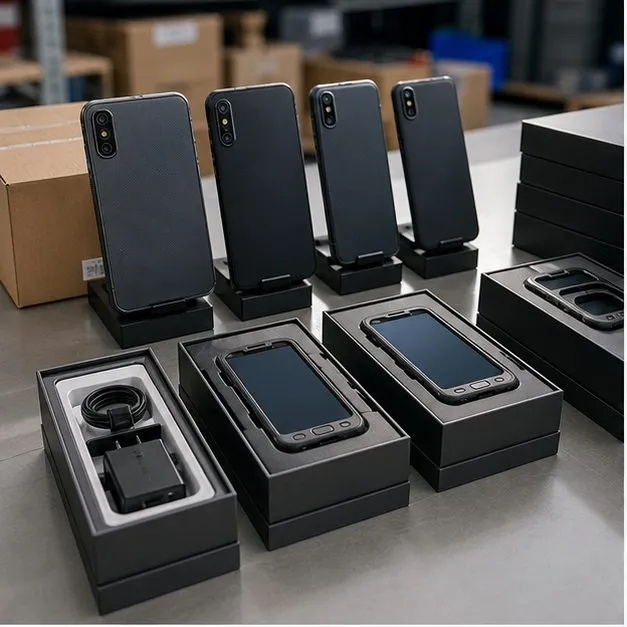
Carrier programs need a repeatable device build, not a one-off phone
A carrier or MVNO device program usually joins several moving parts: model selection, radio and SIM assumptions, branded packaging, onboarding apps, support flows, financing or PAYG controls, repair/replacement path and target-market documentation. Market approval is the dependency that most often moves the launch date rather than the build, and it varies sharply by country: SDPPI certification in Indonesia, for instance, gates phone-class devices behind a local-content certificate that has to be solved months before a shipment, not at customs. Any one of these is manageable; the failure mode is treating them as separate purchases instead of one build. A phone that passes the network test but ships in the wrong retail pack, or a beautifully branded bundle whose APN profile was never validated on the actual SIM, generates the same outcome — returns, support tickets and a stalled program. Vantora turns those inputs into a device build spec and an acceptance matrix before batch staging, so the first commercial batch replicates a sample the program team has already accepted rather than testing assumptions on subscribers. The same evidence pack supports repeat orders: a second batch starts from the recorded baseline of the first, which is what makes a device program repeatable instead of a sequence of one-off phone purchases. Where the commercial model depends on instalments, the control side is scoped in device financing and PAYG locking; the brand side is covered in white-label Android phones.
Carrier and MVNO program map
| Program pattern | Device build focus | Validation evidence |
|---|---|---|
| MVNO branded phone bundle | Private-label presentation, carrier app preload, SIM/APN assumptions and retail pack | Build spec, packaging proof, app test, SIM/APN note and staging record. |
| PAYG or financed device program | Policy-controlled device state, grace/overdue behavior, support and replacement path | PAYG acceptance matrix, known limitations log and role responsibility matrix. |
| Community or restricted-use plan | Approved apps, browser/store posture, language settings and reset behavior | Restricted-function matrix, sample acceptance result and batch label record. |
| Enterprise resale or channel bundle | App-ready device kit for a customer workflow, with partner-safe delivery | Redacted feasibility memo, build spec and white-label handoff record. |
SIM, APN and network preconfiguration
Out-of-box network behavior is where an MVNO bundle wins or loses its first support call. A carrier program build can preconfigure the APN profile for your network (including MMS and tethering settings where the plan allows them), set the preferred network selection behavior, preload the onboarding or top-up app, and define what the first-boot flow shows a subscriber before the SIM registers. Where devices ship with the SIM installed, the staging step can pair SIM and device records so the batch record ties IMEI to ICCID for activation and support lookups. eSIM-based flows are possible on supporting models but are OEM- and platform-dependent and need their own validation pass, because profile download behavior differs across chipsets and Android versions. Dual-SIM policy — which slot is default for data, whether the second slot is open or restricted — is a build decision, not an afterthought. All of these assumptions belong in the build spec, and the sample review should exercise them with your actual test SIMs on the actual target network, not a lab equivalent.
Subsidy locks, financing controls and device state
Carriers subsidizing hardware and MVNOs bundling financed devices usually need some form of lock: a network or subsidy lock that keeps the device on the sponsoring service, or a payment-linked control that manages device state through current, grace, overdue, recovered and paid-off stages. Both are achievable, and both come with conditions worth stating plainly. Lock mechanisms are OEM- and platform-dependent — what a given model supports at firmware level versus what must be enforced through a management agent is confirmed per model during validation, not assumed from a datasheet. Local regulation matters too: some markets restrict or condition SIM locking and mandate unlock paths, so the lock design should be reviewed against the target market before the build spec is frozen. The behavior that needs the most testing is not the lock itself but the edges — what a subscriber in grace period can still do (emergency calls, support contact, payment app), how a recovered device is returned to service, and how a paid-off device is cleanly released. Vantora scopes these state machines with the financing or BSS partner and tests each state in the acceptance matrix; the full pattern is covered in our device financing and PAYG locking program page.
What must be validated before the first commercial batch
The sample review should confirm app readiness, SIM/APN behavior on the live network, radio band fit for the coverage footprint, device controls and lock states, packaging and insert accuracy, serial and IMEI capture into the batch record, repair or replacement flow, and the open items that still depend on the OEM, MDM, carrier core or local market. Two details deserve particular attention because they surface late: IMEI handling (registration requirements, label placement, box-print accuracy) and the returns path (who triages a device that a subscriber returns, and what wipe or lock-release step it goes through before restocking). A known-limitations log kept from the first sample keeps conditional dependencies — an OEM behavior quirk, a pending market document, a carrier-side provisioning step — visible to the program owner instead of buried in email threads. Acceptance is signed by the program owner against the matrix, and the accepted sample becomes the baseline every batch must match.
Records model, OS, app, policy, SIM/APN, packaging and staging requirements.
Pass/fail evidence for app, control, connectivity, packaging and batch handoff behavior.
A visible log for carrier, OEM, MDM, app, market and lifecycle dependencies.
How Vantora supports partner-led carrier opportunities
Carrier opportunities often arrive through system integrators, app companies, distributors or financing partners rather than from the carrier directly. Vantora can review redacted briefs — carrier type, region, quantity band, program pattern and required controls, without the account name — protect the end-customer relationship under a non-circumvention structure, scope white-label delivery where practical and keep the build evidence separate from commercial account ownership. For the partner, that means the acceptance matrix, batch records and known-limitations log are written neutrally, so they can be handed to the carrier as the partner’s own program documentation. Market-entry dependencies — type approval, import documentation, IMEI registration where a market requires it — are treated as named conditional items with owners, coordinated according to the project rather than promised generically, because approval paths belong to the target market and the local applicant.
FAQ
Can Vantora support MVNO branded Android phones?
Yes. Vantora can scope branded presentation, app preload, packaging, SIM/APN assumptions and staged batches, subject to selected model and market validation.
Can devices ship with the SIM installed and the APN preconfigured?
Typically yes. APN profiles, network selection behavior and onboarding apps can be preconfigured in the build, and SIM kitting can be included in batch staging with IMEI-to-ICCID pairing recorded. The exact flow is validated on the sample with your test SIMs on the live network.
Can devices be network-locked or subsidy-locked to our service?
Often, with conditions. Lock mechanisms are OEM- and platform-dependent and confirmed per model during validation, and some markets regulate SIM locking or mandate unlock paths. The lock design, grace behavior and release flow are scoped in the build spec and tested in the acceptance matrix.
Can PAYG or financed-device controls be included?
Yes, when supported by the device and management path. Current, grace, overdue, recovered and replacement states should be tested in the acceptance matrix. See the device financing and PAYG locking page for the full program pattern.
Can a carrier opportunity be reviewed without naming the end customer?
Yes. A redacted brief can describe the carrier type, region, quantity range, device program and controls without exposing the commercial account at first review.
Does Vantora guarantee carrier certification or approval?
No. Carrier acceptance, local certification and import approvals are target-market dependencies that must be confirmed for the selected model and program.
Tell us your workflow and rules.
We turn requirements into deployment-ready devices.