Android Firmware and Software Customization for Validated Builds
Define the Android build layer: GMS or AOSP direction, launcher, app preload, permissions, policy hooks, OTA path, known limitations and sample release note.
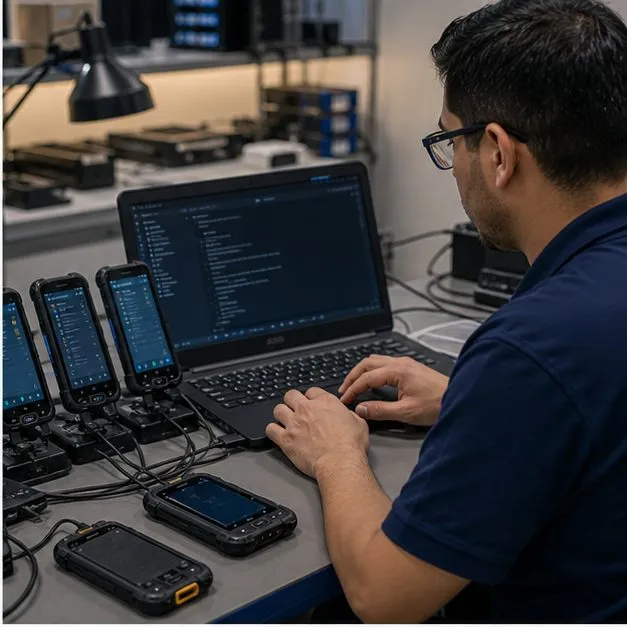
Firmware choices set the ceiling for control
The Android build path determines what is realistic for the rollout. A GMS device supports Google services and many standard enterprise app flows. An AOSP path can support deeper restriction patterns, but it also changes app compatibility, update handling and certification assumptions. Vantora records these tradeoffs in the device build spec and validates them on the selected sample. The two decisions underneath it are compared separately: GMS vs AOSP for the services layer, and MDM vs a custom Android ROM for the control layer.
GMS, AOSP and management path comparison
| Path | Best fit | Main dependency | Validation focus |
|---|---|---|---|
| GMS with MDM/EMM | Enterprise apps, managed Play, standard enrollment | Google services and EMM policy support | Enrollment, app install, permissions and policy behavior |
| AOSP restricted build | Closed app set, no Google services, controlled experience | OEM build access and app compatibility | App function, update path and user recovery flow |
| Custom launcher | Task-first experience or kiosk-like workflow | Launcher permissions and management method | Home behavior, escape paths and support exceptions |
| ROM-level change | System app, deeper restriction or firmware baseline | OEM, source, bootloader and signing access | Release note, OTA and rollback behavior |
Build: apps, permissions and launcher
Firmware and software customization should name the app packages, permission expectations, accounts, background services, notifications, offline logic, launcher entries and update rules. These items become the App and Permission Map so the software team, IT team and device build team are reviewing the same behavior.
Validate: release note and known limitations
A firmware sample must carry a release note. The note records device model, Android version, firmware version, app version, launcher version, policy package, known limitations and open issues. This prevents a sample review from becoming informal and gives production a baseline to reproduce.
Records firmware, app, launcher, policy version, known limitations and accepted behavior for the sample.
Captures OEM, GMS/AOSP, app, policy and OTA constraints before production.
Stage: version control across the batch
A staged production batch should match the accepted firmware baseline. The batch record should include device model, firmware version, Android version, app packages, launcher, policy, OTA position and serial range. If a later reorder uses a changed version, the difference should be visible in the change log.
FAQ
Can Vantora build AOSP firmware?
AOSP builds can be scoped where the selected model and OEM path support it. App compatibility, update path and target-market implications are validated before production.
When is GMS better than AOSP?
GMS is often better when the app depends on Google services, managed Play or standard enterprise enrollment. AOSP fits closed ecosystems where those dependencies are not required.
Can a custom launcher replace the Android home screen?
A custom launcher can be scoped for many devices, but escape paths, permissions and management behavior depend on the model and management stack.
Can OTA updates be controlled?
OTA behavior can be planned and documented, but exact control depends on OEM and firmware path. The sample release note should record the accepted update position.
What is the most important firmware artifact?
The Sample Release Note is the key artifact because it freezes the firmware, app, launcher, policy and known limitations reviewed before batch.
Tell us your workflow and rules.
We turn requirements into deployment-ready devices.