Mobile Device Hardware Customization for Android Rollouts
Scope the physical device layer: scanner, RFID, NFC, camera position, ports, battery, dock, rugged housing and accessory kit, then validate the chosen model before batch staging.
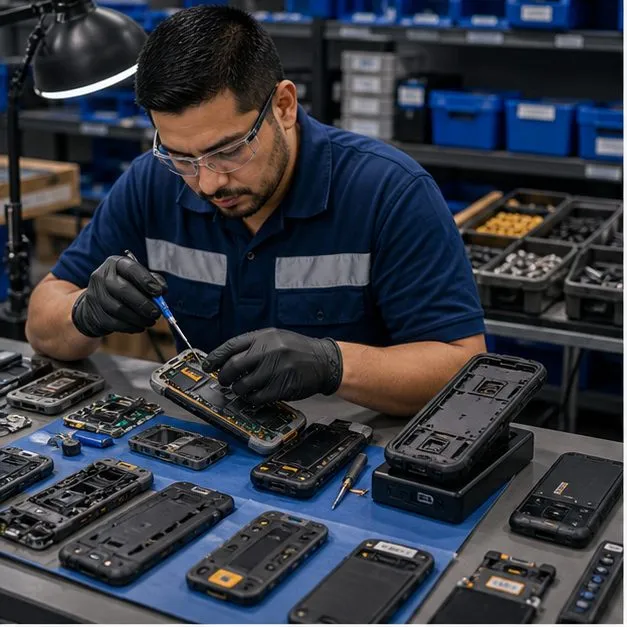
Hardware customization starts with the workflow
A hardware option only matters if it improves the rollout workflow. Barcode capture, RFID reads, camera use, NFC, GNSS, battery life, buttons, ports, docks and rugged housing should be tied to the task the user performs. Vantora maps those requirements to proven Android device platforms and validates the sample before production.
Typical hardware options and validation focus
| Requirement | Typical path | Validation focus |
|---|---|---|
| 1D/2D barcode scanning | Handheld computer or integrated scan engine | Scan distance, symbology, trigger key and app handoff |
| UHF RFID or NFC | Reader module or NFC-capable model | Read range, tag type, antenna position and power draw |
| Camera add, removal or disablement | Policy, firmware or hardware option | Model support, app impact and reset behavior |
| Large or removable battery | Model selection or accessory battery path | Runtime, charge cycle, dock compatibility and spare plan |
| Ports and charging docks | USB, pogo-pin, cradle or vehicle mount | Connector durability, cable path, site charging workflow |
| Rugged housing | IP-rated model or protective kit | Drop, dust, water, glove use and mounting requirements |
Build: pick the lightest viable path
Not every hardware request needs a custom device. Sometimes a proven rugged model with the right scanner or dock is safer than changing the hardware. Deeper hardware work becomes useful when the existing model cannot meet the task. The build spec records the chosen path, the rejected options and the dependency risks. Where that path sits relative to simply configuring a standard model is set out in custom vs off-the-shelf Android devices.
Validate: the hardware must pass in the real app flow
Hardware validation is not only a bench test. The sample should be tested with the actual app or workflow: scan into the right field, read the expected tag range, keep battery life under realistic use, charge in the intended dock and survive the environment expected by the deployment. Results become acceptance rows before the batch moves forward.
A sample matrix for scanner, RFID, camera, battery, dock and ruggedness checks.
Stage: accessories are part of the batch
A device batch can fail because the accessory kit is inconsistent. Staging should record cases, docks, cables, straps, chargers, labels, SIM trays, spare batteries and carton contents. This makes the hardware setup repeatable across sites and reorders.
FAQ
Can Vantora remove or disable a camera?
Camera removal or disablement can be scoped, but the route depends on the selected model, OEM support and policy mechanism. The sample must be validated before batch.
Can you integrate barcode or RFID hardware?
Yes. The right path may be a handheld computer, scanner module, RFID reader model or accessory. Read behavior is validated with the target app and tags.
Do all rugged devices have the same IP rating?
No. IP rating, drop rating and environmental tolerance vary by model and accessory. The build spec names the target requirement and validation evidence.
Can accessories be packed with each device?
Yes. Staging can include case, strap, dock, charger, cable, label, SIM and printed materials, with carton contents recorded per batch.
When is custom hardware not recommended?
If a proven device already satisfies the workflow, changing hardware can add cost, MOQ and validation risk. Vantora recommends the lightest path that meets the requirement.
Tell us your workflow and rules.
We turn requirements into deployment-ready devices.