Handheld RFID Readers for Validated Inventory and Asset Rollouts
Android UHF RFID handhelds prepared with app-ready inventory setup, tag-read validation, policy controls and batch staging for asset tracking and bulk counting.
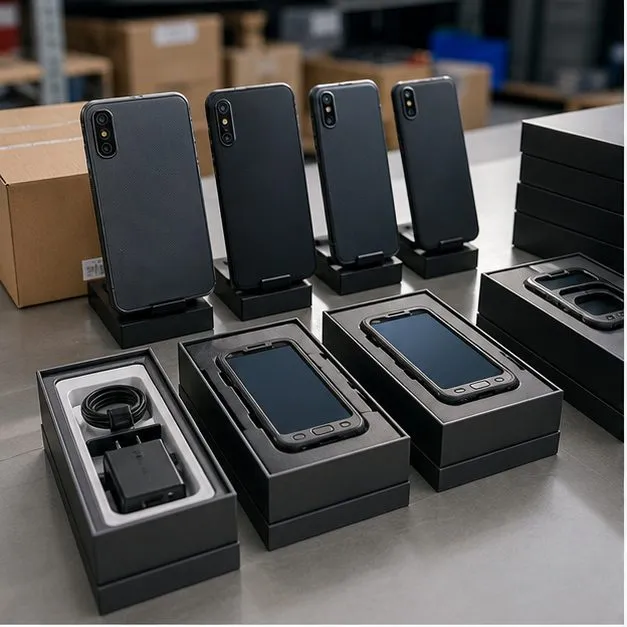
Brief: define the tags, assets and read environment
RFID programs succeed or fail on the actual tag, material, distance and workflow. Vantora starts by mapping UHF tag type, asset material, expected read distance, read volume, warehouse or yard environment, WMS or inventory app, offline requirements, barcode fallback, battery plan and region rules before selecting an Android RFID reader path.
Build: configure reader hardware and inventory software together
The build layer can include UHF RFID reader selection, antenna and power assumptions, optional integrated 1D/2D barcode engine, RFID SDK setup, app preload, inventory or WMS client configuration, MDM enrollment, kiosk posture, asset labels and charging accessories. RFID should be validated as a workflow, because a reader that performs well on a desk can behave differently around metal, liquids, dense pallets or mixed tags. Where tags and barcodes are mixed, the counting workflow itself is scoped in inventory counting devices.
| Validation area | Typical question | Evidence captured |
|---|---|---|
| Tag and material fit | Do the selected tags read reliably on the actual asset surface? | Tag sample, asset material and read-rate notes. |
| Read distance and accuracy | What distance and orientation produce stable reads without excess noise? | Distance, power setting and miss/read observation record. |
| Application integration | Does the inventory app use the RFID SDK and handle duplicates correctly? | SDK path, duplicate logic and sync behavior notes. |
| Batch staging | Can devices ship with profiles, labels, accessories and handoff notes? | Serial records, app state and accessory checklist. |
Validate: test read rate, false reads and operator flow
A pilot RFID handheld should be tested with the real tag population, distance, angles and environment. Vantora validates read rate, missed reads, false reads, barcode fallback, inventory app behavior, duplicate handling, offline capture, battery assumptions, MDM enrollment and charging accessories. The accepted sample records the reader model, UHF settings, app version and known limitations before a batch is staged.
- UHF tag and asset material validation
- Read distance, orientation and power-setting review
- RFID SDK and inventory app integration check
- Barcode fallback and offline capture validation
- Battery, cradle and staging record review
Stage: prepare RFID readers for sites and asset classes
Batch staging can include app preload, reader settings, device labels, serial records, charging cradles, accessory packs, site profiles and handoff notes. If different sites or asset classes require different reader assumptions, those differences should be explicit before devices leave staging.
Rollout: preserve the accepted RFID behavior
RFID rollouts are sensitive to small changes in tags, materials, power settings and app logic. Vantora records the accepted assumptions so future batches and re-orders can be checked against the same tag-read behavior instead of treating the reader as a generic Android handheld.
Validation matrix for tags, read distance, SDK behavior, duplicate handling and offline capture.
Checklist for reader settings, labels, cradles, site profiles and handoff notes.
FAQ
How far can a handheld RFID reader read tags?
UHF read distance depends on reader, antenna, tag type, asset material, power settings and environment. Vantora validates distance with your tags and workflow during the sample stage.
Can RFID handhelds also scan barcodes?
Yes. Many Android RFID handhelds can include an integrated 1D/2D barcode engine for fallback scanning or mixed workflows.
Can the RFID reader integrate with our inventory system?
Yes. Integration usually uses an RFID SDK and your inventory or WMS client. Duplicate handling, sync behavior and offline capture should be validated before production.
Can you test our actual tags and assets?
Yes. The pilot should use your tag samples, asset materials and read environment so the acceptance record reflects real conditions.
Can RFID readers be staged per warehouse or asset class?
Yes. Batch staging can include reader settings, site profiles, asset labels, serial records, cradles and handoff notes.
Tell us your workflow and rules.
We turn requirements into deployment-ready devices.