Android ODM vs OEM: How to Choose the Right Path for an Enterprise Device Rollout
ODM, OEM and integrator are often used interchangeably, but they create different responsibilities. This guide explains which role owns hardware, software, certification, acceptance and batch staging.
- Published
- Updated
The short answer
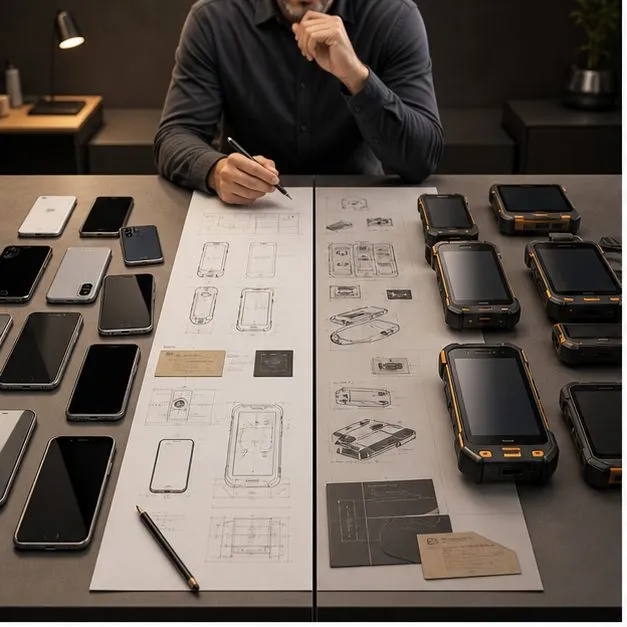
Choose an ODM path when you need an existing hardware platform adapted for a defined project. Choose a deeper OEM path only when the hardware itself must change and the volume justifies the engineering work. Choose a rollout integrator when the failure risk is not the device shell, but the gap between hardware, app, policy, validation and batch delivery. Most organizational Android programs need an ODM-based or stock-model build with strong rollout validation, not a new phone designed from zero. A wider comparison of supplier types — wholesalers, OEMs, ODMs and MDM vendors — sits in how Vantora compares to each.
ODM, OEM and rollout integrator compared
| Role | What it usually owns | Best fit | Typical risk |
|---|---|---|---|
| ODM | Existing device platform, manufacturing and model variants | Known hardware with moderate customization | Buyer still must connect app, policy and acceptance |
| OEM | Brand, product definition and sometimes deeper hardware choices | Large-volume device programs with dedicated roadmap needs | Longer timeline, higher MOQ and more certification burden |
| MDM/EMM vendor | Policy console, enrollment and fleet management | Software management of existing devices | Does not own hardware readiness or batch staging |
| Rollout integrator | Device build layer, sample validation and staged delivery | Partner-led or app-led deployments that need one accepted build | Must keep boundaries explicit and evidence-driven |
Why ODM is often the practical path
An ODM path starts with proven hardware that already exists. That matters because the device has a known mechanical design, component base and production process. For many enterprise rollouts, the value is not a new board design. The value is selecting the right model, confirming target-market constraints, preloading the app, applying policy, validating the sample and staging the batch. This keeps the project closer to manufacturable reality while still producing a custom Android device outcome. That outcome is defined level by level in what is a custom Android device.
When deeper OEM work is justified
Deeper OEM work becomes reasonable when the use case truly requires hardware changes: a scanner module, battery system, port, casing, charging accessory, label position, camera arrangement or enclosure change that cannot be solved through a current model. These changes usually raise MOQ, sample cost, timeline and certification complexity. They also need a clearer responsibility matrix because app, hardware, radio and compliance issues can interact in ways that are hard to diagnose late.
The missing layer: acceptance before batch
The buyer often asks ODM vs OEM because they are trying to assign responsibility. The more useful question is: who turns the selected device into an accepted rollout build? Vantora fills that device build layer. The build spec names the model, app, policy, packaging and region assumptions. The acceptance matrix names what must pass. The batch record ties the production devices back to the accepted sample.
Planning ranges by path
| Path | Typical MOQ pressure | Validation focus | When to choose it |
|---|---|---|---|
| Stock model plus staging | Lower | App install, policy, packaging and batch record | The hardware already fits the job |
| ODM variant | Medium | Model fit, accessory, branding and target-market checks | A proven platform needs moderate adaptation |
| OEM-level change | Higher | Engineering sample, certification impact and lifecycle plan | The use case cannot work on an existing model |
| Integrator-led rollout | Varies by selected path | One accepted build across app, policy and device | Multiple parties must deliver one field-ready device batch |
Questions to answer before contacting suppliers
- What is the app or workflow the device must run?
- Which restrictions, accounts, permissions and update paths must be controlled?
- Which target countries, radio bands and certification constraints matter?
- What quantity bands are realistic for sample, pilot and first production batch?
- Which party will accept the sample and what pass/fail criteria will they use?
FAQ
Is an ODM the same as an OEM?
No. In practical Android device projects, an ODM usually provides an existing device platform and manufacturing capability, while an OEM role can involve broader product definition, brand ownership or deeper hardware decisions. Exact usage varies by supplier, so responsibility must be written into the build spec.
Do I need an OEM-level project for a custom Android device?
Often no. Many projects can use a proven stock or ODM platform with app preload, launcher, policy, packaging and sample acceptance. OEM-level changes are for requirements that cannot be met by existing models.
Who handles MDM in an ODM project?
The MDM or EMM vendor owns the management platform. Vantora maps that policy to the device behavior, tests the sample and records dependencies, but the selected management stack remains a separate dependency.
Which path is fastest?
A stock model plus staging is usually fastest. ODM variants take longer, and OEM-level hardware or firmware work takes longest because it adds engineering, sample and possible certification steps.
How should we reduce risk?
Write a device build spec, validate a real sample against an acceptance matrix and keep a responsibility matrix for app, OEM, MDM, certification and staging boundaries.
Tell us your workflow and rules.
We turn requirements into deployment-ready devices.