Vantora vs Phone Wholesalers, OEMs, ODMs, and MDM Platforms
Choose the provider whose controlled output closes the project’s remaining gap. A wholesaler supplies units, an OEM controls the official product, an ODM can perform contracted engineering, and an MDM or EMM manages supported policy. Vantora coordinates the selected device, app, management path, acceptance evidence, batch preparation and handoff within an agreed scope.
- Published
- Updated
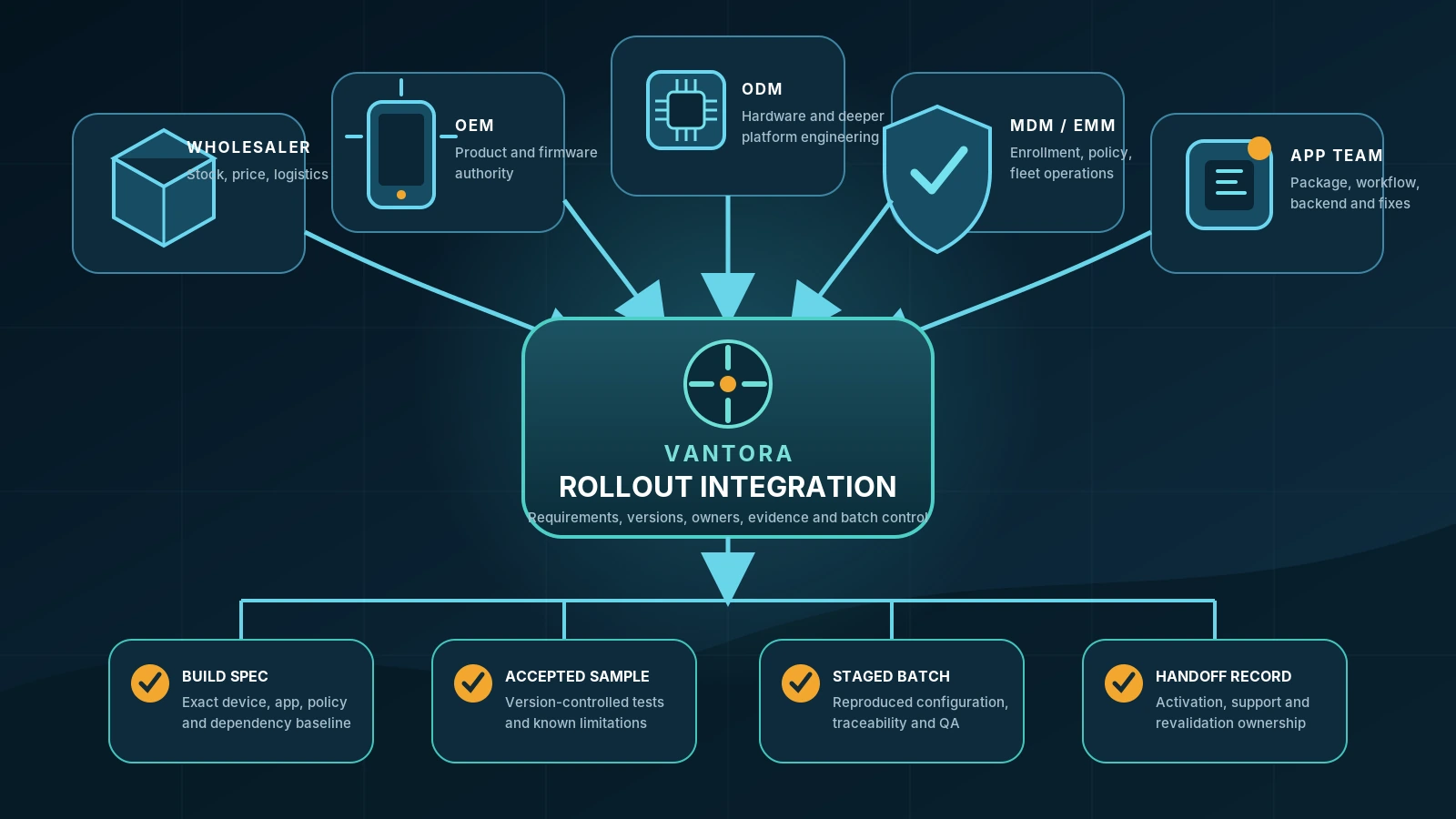
Five Roles, Five Contracted Outputs
A buyer looking for organizational Android devices can receive five different answers to the same request. None is automatically wrong; each describes a different authority and contracted output. Compare the exact device, required authority, published limits, delivered evidence and evidence boundaries—not only the supplier label.
- A phone wholesaler or distributor may quote available models, quantity, price and freight.
- An OEM may define the finished product, official firmware, lifecycle and warranty.
- An ODM may propose deeper hardware, enclosure or Android platform engineering.
- An MDM or EMM provider may demonstrate supported enrollment, policy, app distribution and fleet commands.
- Vantora may map the device, app, policy, sample, batch and handoff dependencies before recommending a route.
Why This Comparison Matters Before You Select a Supplier
A common project risk is an unowned interface between suppliers. The decision should begin with a narrower question: what output must this party produce, what authority does it control, and what evidence will show that its output is ready for the next project stage? A single company may perform several roles, so the signed scope matters more than the label on a website — and where the question is simply who is active in this space at all, the survey of custom Android device manufacturers names the vendors and what each one publicly positions around. Published supplier positioning also leaves a structural mid-volume gap: some established custom-device vendors publicly scope MDM-only configuration below roughly 50 units and full custom manufacturing from about 20,000 units, so a program sitting between those bands often matches no standing offer on either side and has to be assembled from the roles below — which is exactly the integration seam this comparison is written for. Vantora works inside that band, from around 500 units upward.
- Procurement selects a model, but nobody confirms the exact regional SKU, firmware build or remaining lifecycle window.
- The app team provides a package, but nobody owns first-run permissions, managed configuration, offline behavior or update recovery on that build.
- The MDM team creates a policy, but nobody validates kiosk behavior, reset recovery or peripheral workflows on the exact device.
- A pilot works, but production units arrive with a different memory variant, patch level, preload state or packaging configuration.
The Core Difference: Specialist Authority vs Rollout Integration
A wholesaler, OEM, ODM and MDM platform normally controls a specialist layer. Vantora’s contracted role is to coordinate and validate the integration path within the agreed project scope. The decisive question is whether each deliverable is written into the scope, tied to a controlled version and accepted with evidence.
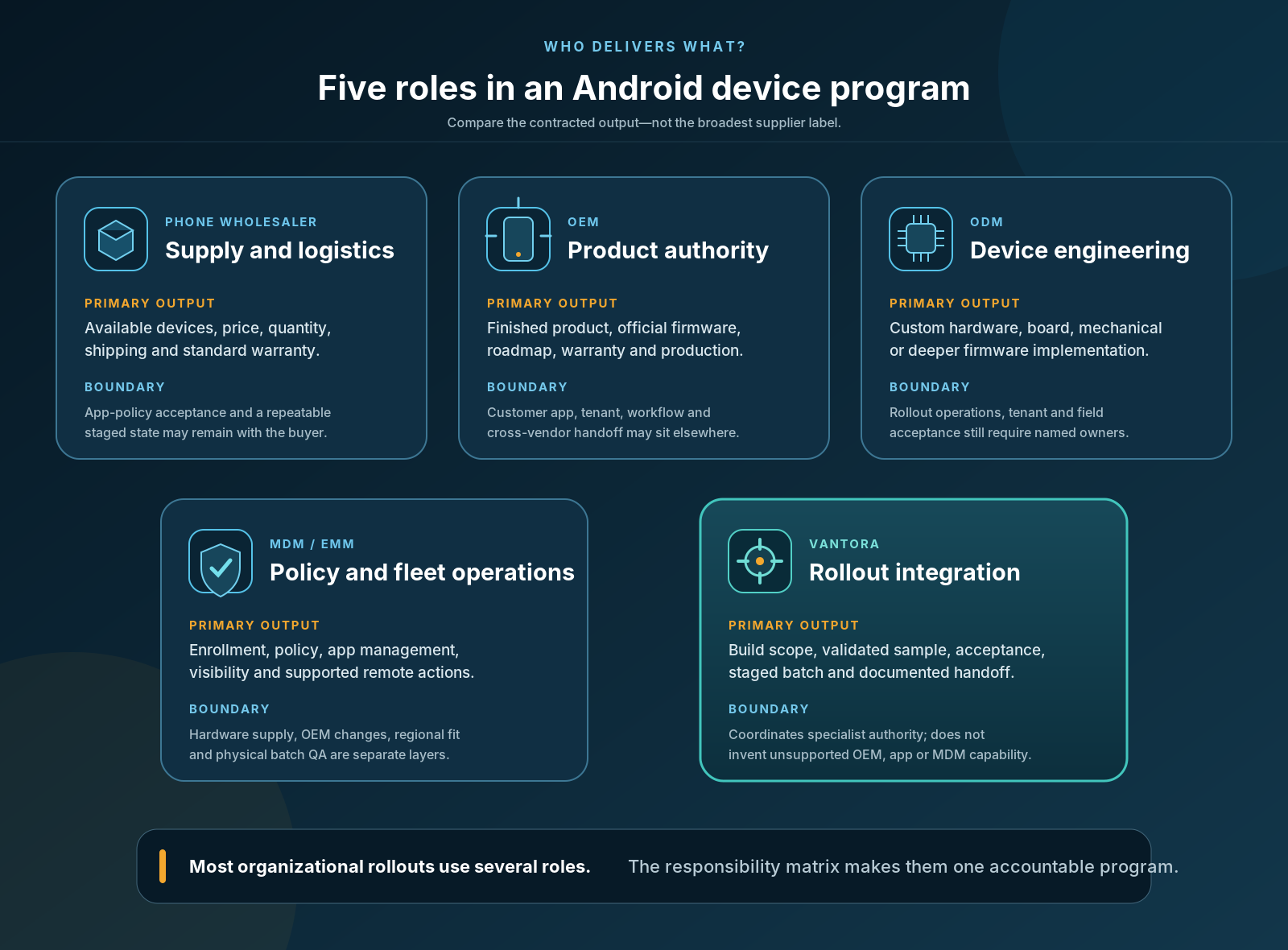
| Role | Primary authority | Typical deliverable | What it does not normally prove | Evidence to request |
|---|---|---|---|---|
| Phone wholesaler or distributor | Inventory, pricing and shipment | Available devices, quantity, logistics and standard warranty | App behavior, policy acceptance, firmware control or batch consistency | Exact SKU, source, lead time, warranty route and shipment record |
| OEM | Finished product and official firmware | Product, firmware, lifecycle, regional variants and manufacturer support | Customer app workflow, MDM tenant behavior or project handoff | Model and SKU record, firmware commitment, change notice and support boundary |
| ODM | Device engineering and manufacturing | Adapted hardware, firmware, tooling and production output | Customer application, EMM operations or field rollout ownership | Engineering scope, NRE, sample gates, BOM and production test plan |
| MDM or EMM platform | Supported enrollment, policy and fleet controls | Console, agent or DPC, policies, app distribution and commands | Hardware fit, supply continuity, physical staging or complete app workflow | Supported mode, policy version, enrollment record and test result |
| Vantora rollout integrator | Cross-layer device-program coordination | Build spec, accepted sample, evidence, staged batch and handoff | Authority reserved to the OEM, app owner, EMM, carrier, importer or customer | Responsibility matrix, acceptance matrix, batch record and limitations log |
Six Published Constraints That Change the Supplier Decision
Official documentation can define platform mechanisms and limits, but it cannot prove that a quoted supplier, exact SKU, EMM configuration or production batch meets the project. Use each published fact to create a buyer action and an evidence boundary.
| Published constraint | What it establishes | What it does not establish | Buyer action |
|---|---|---|---|
| AMAPI lists five full-management methods for company-owned devices: zero-touch, QR, sign-in URL, NFC and DPC identifier. QR requires Android 7.0+; zero-touch Android 8.0+ with a Pixel 7.1+ exception; sign-in URL is not suitable for dedicated devices. | Ownership, management mode, Android version and provisioning route are coupled. | That every EMM exposes every route or that an eligible OS makes a specific SKU acceptable. | Freeze the exact SKU, build, management mode, EMM and route before sample approval. |
| In Google zero-touch, a participating reseller assigns device identifiers to the customer account and the customer applies a configuration. | Purchasing channel, account assignment and configuration are functional dependencies. | That a quoted reseller or SKU is eligible or that first boot will succeed on the target network. | Name the owners of eligibility, assignment, configuration, connectivity and first-boot evidence. |
| The Common Android Reseller Library documents asynchronous claim and unclaim operations of up to 100,000 devices per operation. | A documented maximum for one asynchronous library operation. | Inventory, staging throughput, app acceptance, physical QA or delivery performance. | Accept account-assignment records and physical batch evidence separately. |
| AMAPI can postpone automatic Play app updates for up to 90 days, postpone automatic OS-update installation for up to 30 days, and define annual freeze periods of up to 90 days separated by at least 60 days. | Bounded policy semantics; OS postponement excludes security updates, while freeze periods block incoming updates including security patches. | That every EMM exposes the controls or that an OEM or carrier will publish a compatible build. | Assign OEM availability, EMM policy, regression testing and revalidation ownership. |
| Published OEM support periods and update cadences are model- and clock-specific. | The support start rule, named models and documented cadence at the time checked. | A new support term beginning on the purchase date or a guaranteed patch-arrival SLA. | Record the launch date, remaining window, regional SKU, cadence and caveats. |
| AOSP defines Android compatibility through an implementation that complies with the CDD and passes CTS; OTA packages must be signed with a key expected by the system. | Compatibility and update signing require specific technical controls and authority. | Automatic GMS licensing, commercial key ownership or customer-workflow acceptance. | Contract the build, signing, compatibility, GMS, OTA, recovery and change-control owners. |
Wholesaler or Distributor: Prove Identity, Source and Enrollment Eligibility
A standard-device purchase can be enough when the exact regional SKU is already accepted and the buyer owns configuration, QA and support. Zero-touch shows why inventory source can affect function: participating resellers assign eligible device identifiers to the customer account, while the customer or its management provider applies the configuration. After a missing registration or configuration is corrected, the device generally needs a factory reset for zero-touch provisioning to run.
- Request the exact model, regional SKU, identifiers, source and assignment record where applicable.
- Record the firmware and preload state, substitution rule, accessories, warranty route and shipment condition.
- Treat optional staging, zero-touch registration, labeling or software loading as explicit deliverables.
- Do not treat API operation capacity as evidence of inventory, physical throughput or batch QA.
When a Phone Wholesaler May Be Enough
A wholesaler may be sufficient when the conditions below are true. Otherwise it can still supply the units, but another party must own the remaining integration and acceptance work.
- The exact standard model and regional SKU are already approved.
- The customer owns enrollment, configuration, staging and support after delivery.
- The app and MDM stack are already validated on the accepted build.
- Regional fit, lifecycle, replacements and substitutions are controlled.
- No version-controlled sample or custom factory state is required.
OEM: Prove the Exact Product Commitment and Remaining Support Window
An OEM controls the finished product, official firmware, supported variants and manufacturer lifecycle. That authority matters when the project depends on a signed system image, device-specific API, scanner service, hardware-button behavior, regional SKU, security-update path or warranty commitment. Brand-level language is not enough; require the exact model, support start rule, remaining window and change boundary.
- Google states that Pixel 8 and later receive seven years of updates from first US Google Store availability; Pixel 8 and Pixel 8 Pro began that clock in October 2023.
- As checked July 21, 2026, Samsung grouped selected models into monthly, quarterly and biannual security-update lists and noted that timing can vary by market, network provider and model.
- As checked July 21, 2026, Zebra’s dynamic support table listed ET40 with Android 14 as its final supported OS and ET401 with Android 19; it listed MC3400 Gun Standard with Android 15 and Expanded or Full Feature with Android 18.
- These examples prove why family names and purchase dates are incomplete acceptance baselines; they do not generalize to other models or future list revisions.
ODM or Engineering Partner: Prove Build and Signing Authority
An ODM route can be appropriate when a catalog device cannot meet a critical physical or platform requirement and the expected volume justifies engineering, tooling and a longer validation path. “Custom ROM available” or an Android version label is not proof of compatibility, GMS status, update authority or reproducibility. See Android ODM vs OEM for the wider product-development comparison.
- Define the board, enclosure, component, driver, framework and firmware scope.
- Require CDD and CTS evidence where Android compatibility is claimed; treat GMS licensing as a separate path.
- Name the source, build-pipeline, platform-key, release-key, OTA, recovery-image and long-term handoff owners.
- Tie NRE, tooling, BOM control, sample gates, production tests and change control to the accepted build.
- Use deeper ODM or firmware work only when a validated requirement cannot be met through a lighter route.
MDM or EMM Platform: Prove the Exact Policy Path
An MDM or EMM platform controls supported enrollment, policy, app distribution, visibility and fleet operations. The exact result still depends on the platform, license, Android version, ownership mode, provisioning route and device build. Google’s Android Management API provisioning guide documents the underlying paths, but a platform feature page or successful console enrollment does not prove the complete device workflow.
- Request the exact product and license, supported-device record, ownership mode, provisioning route, policy export and app-distribution method.
- Validate commands, kiosk or launcher behavior, reset, recovery and policy refresh on the reference sample.
- Device Trust can report installed and Google-published patch levels, OS version and pending OTA state, but Google notes that a published patch may still be unavailable until the OEM or carrier releases it for that device.
- An MDM can expose supported controls; it cannot manufacture hardware, create an OEM firmware release or perform physical batch QA.
- See MDM vs Custom Android ROM and App, MDM and Kiosk Integration for the policy and firmware boundary.
Vantora: Require Project Evidence, Not a Supplier Label
Vantora is a B2B Android device rollout integrator, not a consumer retailer, universal ODM or MDM SaaS platform. Within the agreed scope, its role is to connect the selected hardware, app, management path, sample, evidence, batch and handoff into one project-specific baseline. It tests and records agreed interfaces without assuming authority reserved to the OEM, app owner, EMM, carrier, importer, customer or regulator.
- A redacted project brief and feasibility record.
- An exact model, regional-SKU and build shortlist.
- A responsibility matrix naming customer and external owners.
- A device build specification covering hardware, firmware, app, policy and staging state.
- A version-controlled reference sample and acceptance matrix.
- A known-limitations, dependency and deviation log.
- A batch-staging, QA and identifier record where applicable.
- Activation, warranty, support, replacement and revalidation instructions.
What Vantora Integrates—and What Remains With Other Owners
The responsibility model is intentionally multi-owner. A credible rollout does not hide dependencies by pretending one party controls everything.
| Project layer | Typical owner or authority | Vantora’s integration role | Acceptance evidence |
|---|---|---|---|
| Hardware model and regional SKU | OEM, distributor or ODM | Shortlist against workflow, bands, lifecycle, accessories and supply assumptions | Exact model and market-fit note |
| Android and firmware | OEM or ODM | Record the accepted build and coordinate agreed changes or dependencies | Build fingerprint, firmware version and change record |
| App package and backend | App owner or SaaS provider | Validate install, launch, permissions, login, offline use, update and recovery | Package and version record with scenario results |
| MDM or EMM tenant and policy | Customer, SI or MDM provider | Map controls to the exact device, ownership mode and enrollment path | Policy version, enrollment record and exception log |
| Kiosk, launcher or restricted-use behavior | EMM, OEM, launcher developer or app owner | Test the intended journey, escape paths, reboot and reset behavior | Kiosk scenario and recovery test |
| Network, SIM, APN, VPN and certificates | Carrier, customer IT, EMM or network owner | Validate representative connectivity assumptions on the sample | Network configuration and observed result |
| Peripherals and accessories | OEM, accessory supplier and app owner | Test representative scanner, RFID, printer, dock or charging workflow | Device and peripheral record with scenario result |
| Certification and importer obligations | OEM, importer, customer and local authorities | Surface dependencies and confirm document scope without replacing legal approval | Market-access checklist with named owners |
| Physical staging and batch QA | Vantora and contracted production partners | Reproduce the accepted state and record deviations | Batch QA and identifier map |
| Activation, support and replacement | Customer, SI, OEM, distributor and Vantora by scope | Document the handoff, escalation and revalidation triggers | Handoff pack and responsibility matrix |
One Zero-Touch Requirement Exposes Five Responsibility Areas
No single supplier label completes the zero-touch chain, and one party may own more than one area. An MDM license without eligible reseller assignment is incomplete; an assigned device without a configuration can start unmanaged; and successful first boot still does not prove the app, peripheral, recovery, update or batch workflow. See the Android provisioning-method selection guide for the wider route decision.
- 1OEM or device program: confirm that the exact model and build meet the applicable zero-touch and GMS requirements.
- 2Participating reseller: register the eligible device identifiers and assign them to the customer account.
- 3Customer and EMM: create and apply the enterprise configuration, DPC, policy and enrollment details.
- 4Network and first-boot environment: reach the required services and complete setup under representative deployment conditions.
- 5Integration and acceptance owner: test the recorded combination, document exceptions and define the batch release rule.
Convert Every Sales Claim into an Acceptance Item
A quotation, product demonstration, support page or enrollment record can be useful evidence, but it proves only its own layer. Translate each sales claim into a minimum evidence set and a stop or rescope trigger before approval.
| Sales claim | Minimum evidence before approval | Stop or rescope trigger |
|---|---|---|
| Zero-touch ready | Participating reseller path, eligible exact identifiers assigned to the customer, configuration applied and clean first-boot evidence on the target network | Device is absent from the account, starts unmanaged or requires an undocumented manual step |
| Seven years of updates | Exact model policy, support start date, remaining window, current cadence, region or carrier caveats and named update owner | The quote relies on brand-level language or counts from purchase without source support |
| Custom firmware available | Build identity, compatibility and GMS status where claimed, release-key owner, signed OTA path, recovery plan and support boundary | The supplier cannot identify signing or update authority, or cannot reproduce the sample build |
| Supports MDM or kiosk | Exact OS and build, ownership mode, provisioning route, policy export, app and peripheral tests, reboot, reset and recovery evidence | The claim is based only on OS version, a support list or console enrollment |
| Rollout-ready batch | Accepted sample baseline, identifier and build controls, repeatable staging and QA method, deviation rule and handoff owners | Substitution, unrecorded build change, policy drift or a failed critical scenario |
Which Provider Should You Contact First?
Start with the party whose authority matches the first unresolved decision, then make every cross-party dependency explicit.
| Start with | When this is the first unresolved authority |
|---|---|
| Phone wholesaler or distributor | The exact standard model is approved, the buyer owns configuration, and price, availability and shipment are the remaining decisions. |
| OEM | The requirement depends on official product capability, firmware, lifecycle, warranty, regional variants or a signed software change. |
| ODM or engineering partner | No existing model meets a critical physical or platform requirement and the project can justify engineering, tooling and a longer validation path. |
| MDM or EMM provider | The hardware is selected and the primary question is management architecture, policy, licensing, enrollment or fleet operations. |
| Vantora | Several layers are connected and the buyer needs an exact reference sample, cross-supplier acceptance evidence, controlled batch state and documented handoff. |
Acceptance View: Questions Before Choosing the Supplier Route
Use this checklist before treating a quote, demonstration or enrollment as evidence that the complete rollout is ready.
- Is the exact model, regional SKU, memory variant, Android version and firmware build recorded?
- Are the approved app package, version, signature source and distribution path documented?
- Are the exact EMM, license, ownership mode, provisioning route and policy version recorded?
- Have the representative workflow, kiosk restrictions, reboot, reset, offline use, update and recovery been tested?
- Are target-market bands, connectivity, certifications, peripherals and importer assumptions documented?
- Is the accepted sample tied to a build specification, responsibility matrix and acceptance evidence?
- Can production units be compared with the accepted sample using a defined QA method and stop rule?
- Are activation, support, replacement, escalation and revalidation owners documented?
Keep the Evidence Boundaries Visible
Clear limits make a supplier decision stronger. They show which layer has been established, which remains conditional and which needs another owner.
- Supplier labels are not standardized scopes; compare the signed statement of work, authority and acceptance evidence.
- A documented platform capability is not proof that an exact SKU, EMM, app or network has passed.
- A published support duration does not restart at purchase or guarantee a patch-arrival date.
- A reseller assignment record or API operation is not physical staging or batch QA.
- CDD and CTS compatibility is not automatic GMS licensing or customer-workflow acceptance.
- A sample result applies to its recorded model, build, app, policy, environment and scenarios—not every future change.
- Project validation does not replace certification, privacy, carrier, importer or sector-specific review.
Recommended Path: From Specialist Inputs to a Validated Rollout
Specialists remain responsible for their own layers. The rollout path connects their outputs to one controlled baseline. See How a Validated Android Device Rollout Works for the wider checkpoint model.
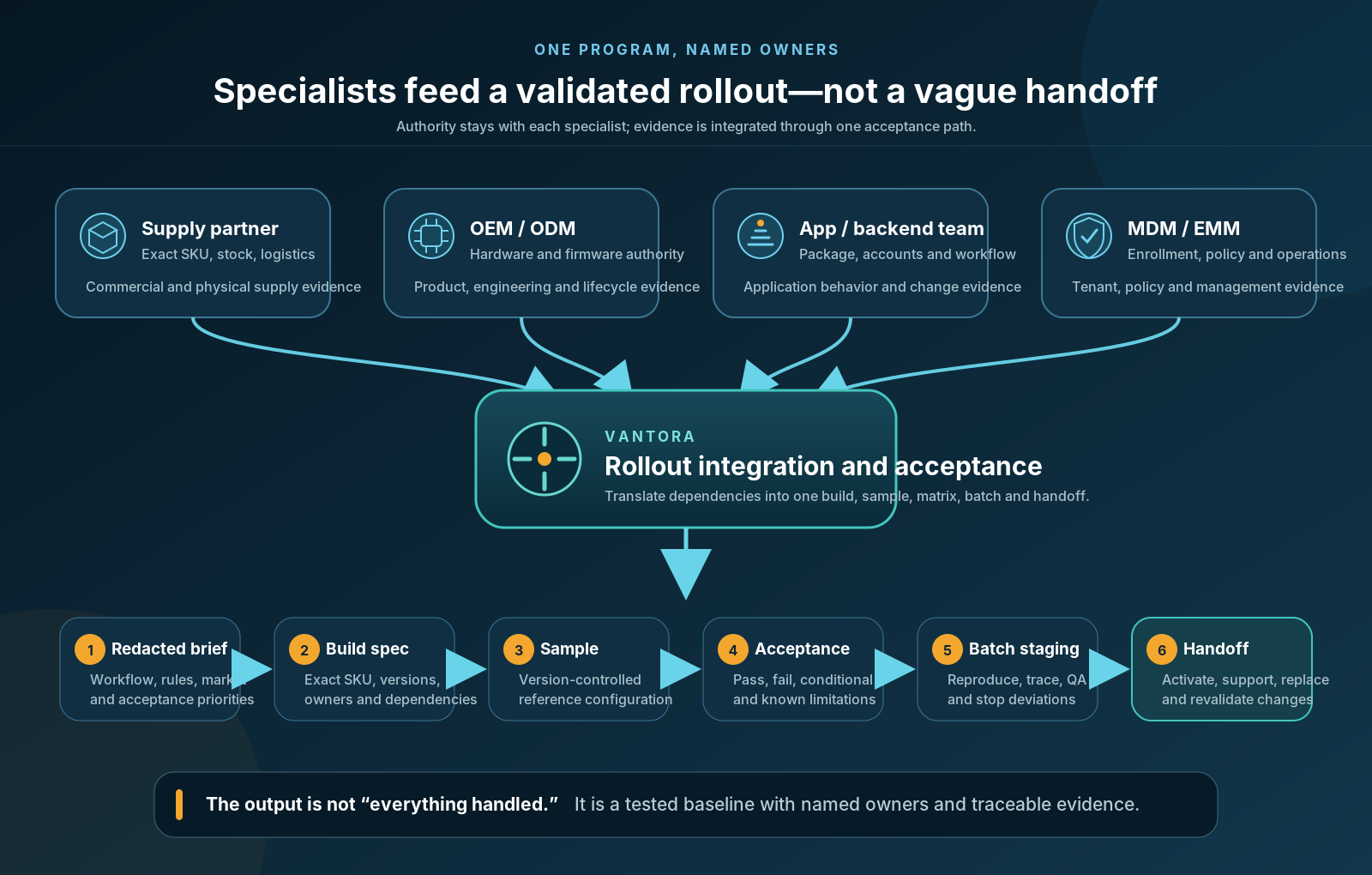
- 1Capture supplier inputs. Use a redacted brief to define countries, workflow, app, device form, quantity range, controls, peripherals and acceptance priorities.
- 2Scope the integration. Map reseller eligibility, OEM lifecycle and build authority, EMM limits, app ownership, dependencies and approval owners.
- 3Accept the exact sample. Record the SKU, build, app, policy, provisioning, connectivity, accessories, scenarios, evidence and limitations.
- 4Stage the batch. Reproduce the accepted baseline, apply identifier and build checks, and stop release on a defined critical deviation.
- 5Complete the handoff. Name activation, support, replacement, update, exception and revalidation owners.
Choose the Evidence Before the Label
A phone wholesaler, OEM, ODM and MDM platform can each be essential. The mistake is asking one specialist’s output to prove a different layer. Request a Feasibility Review with the workflow, countries, app, device type, management requirements, quantity range and acceptance priorities. Vantora can map the owners, identify the lightest feasible route and define what must be proved before batch approval.
Official References
Official sources checked July 21, 2026. Dynamic OEM model lists should be rechecked at the next substantive revision:
- Google: Enroll and provision a device
- Google: Zero-touch enrollment overview
- Google: Zero-touch enrollment for IT admins
- Google: Common Android Reseller Library
- Google: Android Management API policy reference
- Google: Device Trust from Android Enterprise
- Google: Pixel software-update policy
- Google: Pixel availability dates
- Samsung: Security Updates Scope
- Zebra: Supported Android Versions
- AOSP: Android Compatibility program overview
- AOSP: Sign builds for release
FAQ
Is Vantora a phone wholesaler?
Vantora can coordinate device sourcing as part of a project, but its differentiating role is not ordinary inventory resale. It integrates device selection with the app, policy, sample validation, acceptance evidence, batch staging and handoff required for the agreed rollout.
Is Vantora an OEM or ODM?
No. Vantora coordinates OEM or ODM outputs where their authority is required; it does not assume their product, signing, engineering or manufacturing authority. The OEM or ODM remains responsible for the scope it accepts.
Does Vantora replace our MDM or EMM platform?
No. An existing MDM or EMM can remain the management layer. Vantora maps its supported controls to the exact device, app, ownership mode and provisioning path, then validates the applicable workflow on the reference sample and during staging.
Can one supplier perform several of these roles?
Yes. A distributor may provide staging, an OEM may offer integration, an ODM may bundle software, and an MDM partner may resell hardware. The buyer should still separate each deliverable, authority, acceptance test and support boundary.
When is Vantora most useful?
Vantora is most useful when the project crosses supplier boundaries and needs the exact device, app, policy and workflow accepted together, reproduced across a batch and handed over with named owners and evidence.
Do all projects require custom firmware or ODM development?
No. Many rollouts are better served by a mainstream OEM device plus standard Android Enterprise and MDM or EMM controls. Deeper firmware or ODM work should be used only where a validated requirement cannot be met reliably through a lighter path.
Is zero-touch enrollment proof that a device is rollout-ready?
No. Zero-touch establishes an enrollment path only when device eligibility, participating-reseller assignment, configuration and setup conditions are satisfied. The app, policy, peripherals, recovery and batch consistency still require acceptance.
Does a published device-support period restart when the device is purchased?
No. Use the exact model’s published start rule and calculate the remaining support window at procurement time. Brand-level duration language is not enough.
Tell us your workflow and rules.
We turn requirements into deployment-ready devices.