Custom Smartphones for Validated Android Device Rollouts
Private-label Android smartphones prepared as an app-ready, policy-controlled and rollout-validated device fleet, from redacted brief to sample acceptance and batch staging.
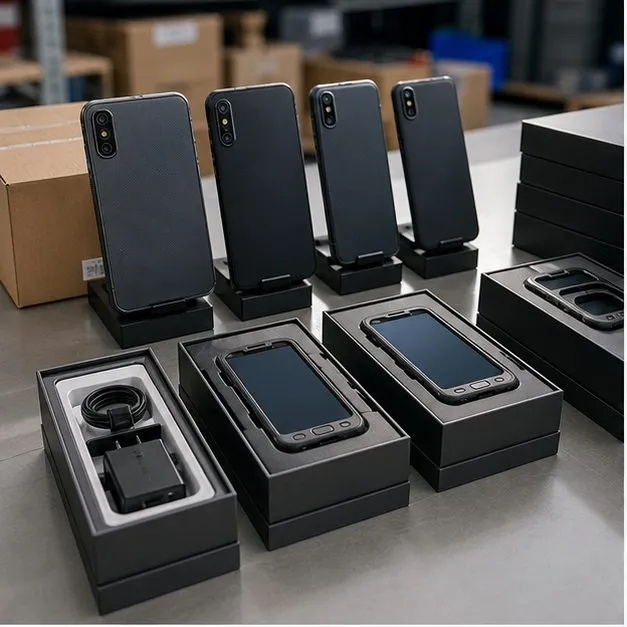
Brief: define the phone program before choosing a handset
A custom smartphone program should start with the operating rules, not with a catalogue model. The question of whether a mainstream branded handset can carry the program at all is answered candidate by candidate in mainstream Android phone as a controlled project device. Before any hardware shortlist exists, Vantora maps who will use the phone, which applications must run, whether Google Mobile Services are required or explicitly unwanted, which regions and carrier bands matter, what the packaging must say, and which controls must remain in place after a factory reset. The brief also captures the quantity band, reorder expectations, accessory needs and the support boundary between the buyer, Vantora and any management platform. That structure lets the team separate cosmetic private-label work from deeper build-layer requirements such as launcher behavior, permission defaults, enrollment method and staging depth — two projects that both say custom phone can sit at completely different cost and timeline levels once these answers are written down. For agencies, integrators and app companies working on behalf of an end customer, the brief can be redacted: the project is described by workflow, region and volume band while the end-customer name stays out of the document. The partner keeps the customer relationship, and a responsibility matrix records who owns app support, device warranty and field escalation before anything is ordered.
Typical configurable specification ranges
Most custom smartphone programs are configured from proven OEM Android platforms rather than designed from zero, so the practical scoping question is which specification ranges are realistic, not what can be imagined. The table below shows the typical ranges Vantora uses in scoping conversations. Every figure is a typical value, subject to model availability, OEM roadmap and project validation — none of it is a promise about a specific device, and the final specification is fixed only on the accepted, versioned sample. Treat the ranges as a way to write a realistic brief: a requirement outside these bands is not a rejection, but it moves the project into a different feasibility, quantity and cost conversation that must be validated before commitments are made.
| Specification area | Typical configurable range | Validation note |
|---|---|---|
| Display size | 5.5–6.8 inches typical | Panel type, brightness and glass options are model-dependent; confirm readability in the real work environment on the sample. |
| Battery capacity | 4,000–7,000 mAh typical | Real endurance depends on app, screen and radio load; validate against a full shift or usage day, not the datasheet figure. |
| Memory (RAM) | 3–12 GB typical tiers, commonly 4 / 6 / 8 GB | Match to app footprint and multitasking needs; confirm with the software team before freezing the tier. |
| Storage | 32–512 GB typical tiers, commonly 64 / 128 / 256 GB | Budget headroom for OS updates and local data; memory-card expansion is model-dependent. |
| Android version | Recent releases, typically Android 13–16 at program start | Version, update policy and patch cadence are OEM-dependent; the accepted sample records the exact build. |
| Google services | GMS build, AOSP build or managed-Play configuration | GMS licensing status and AOSP feasibility are model- and OEM-dependent; this decision gates app compatibility and must precede sample approval. |
| Connectivity | 4G LTE typical baseline; 5G, NFC, dual-SIM and GNSS as model-dependent options | Carrier bands, SIM strategy and roaming assumptions are confirmed per target region during feasibility review. |
Build: turn proven Android hardware into your device build layer
The build layer is everything that turns a generic handset into your device: logo placement, boot animation, wallpaper, packaging, app preload, launcher defaults, permission settings, APN and Wi-Fi profiles, asset labels and first-run behavior. Vantora normally starts from proven OEM Android smartphone platforms rather than designing a phone from zero, then narrows the candidate list against screen size, battery, memory, camera, NFC, GNSS, radio bands, Google service requirements and the target-market certification path. Working from an existing platform keeps the risk profile honest: the hardware is already in production, so validation effort concentrates on the layers the project actually changes. Each layer in the table below carries its own validation question, and the acceptance matrix for the program is essentially these questions written out as testable rows.
| Customization layer | Typical scope | Primary validation question |
|---|---|---|
| Branding and packaging | Logo, boot screen, wallpaper, box, inserts and SKU label | Does the customer-facing identity match the channel requirement? |
| App-ready setup | APK preload, permissions, login path and update assumptions | Can the target app run cleanly on the selected OS and services? |
| Policy control | Launcher, app allowlist, restrictions, enrollment and reset behavior | Do the controls survive the expected field conditions? |
| Rollout staging | IMEI/serial records, asset labels, packaging state and handoff notes | Can the approved sample be repeated across a batch? |
Branding levels: from packaging identity to firmware identity
Branding is not one decision — it is a ladder, and each rung changes the MOQ sensitivity, tooling need and validation depth of the program. A packaging-level program can often move quickly because it touches artwork and kitting rather than the device software. A firmware-level identity program is a different commitment: it typically needs OEM cooperation, longer validation and stricter version control, because the changes live below the reset line. Most programs land somewhere in the middle, combining a cosmetic level with a software-identity level. The useful discipline is to name the level explicitly in the brief so the quote, the sample plan and the acceptance matrix all describe the same program.
| Branding level | What changes | Typical dependency |
|---|---|---|
| Level 1 — Packaging and accessories | Box, inserts, quick-start guide, labels, charger and cable presentation | Artwork approval and print lead time; lowest MOQ sensitivity of the four levels. |
| Level 2 — Device cosmetic | Logo print or engraving, color options, housing finish | Model- and quantity-dependent; some housings accept a logo only, others allow wider changes. |
| Level 3 — Software identity | Boot animation, wallpaper, launcher defaults, preloaded apps, default settings | Requires firmware or configuration access; scope is OEM- and platform-dependent. |
| Level 4 — Firmware-level identity | System-level device naming, locked configuration, persistent settings that survive reset | Deepest level; needs OEM cooperation, longer validation and strict sample version control. |
Validate: approve a sample by apps, policy and region
A phone sample is only useful when it is versioned and tested against the real deployment, not admired on a desk. Vantora validates the application stack, the Google or AOSP dependency, camera and sensor behavior, SIM and band assumptions, launcher rules, sideloading posture, factory-reset behavior and the management enrollment path. Where CE, FCC or other market-specific documentation is relevant, the model and target market determine what already exists and what must be coordinated — certification is always a per-model, per-market question, never a blanket statement. The output of validation is not a feeling that the phone seems fine; it is a completed acceptance matrix with pass, fail and conditional rows, plus a sample version record that captures firmware build, app package versions and configuration state. That record is the contract between the sample everyone approved and the batch that follows it.
- App compatibility, permission and update-path review on the exact target build
- GMS, AOSP or managed-Play dependency check before approval
- Policy, launcher and reset-behavior review under realistic conditions
- SIM, APN, carrier band and region fit check per target market
- Camera, NFC, GNSS and sensor behavior spot checks where the app depends on them
- Sample version record: firmware build, app versions and configuration state
From approved sample to batch production
The path from one good sample to a repeatable batch is where custom phone programs succeed or quietly fail. Vantora runs it as a staged sequence: feasibility review against the brief, configuration freeze, sample build, acceptance testing against the matrix, an optional pilot batch, then volume production with pre-shipment checks against the accepted sample. Configuration-level samples are typically available within one to three weeks after the configuration freeze; firmware-level samples typically take longer because OEM build cycles are involved — both figures are typical and depend on model, OEM scheduling and customization depth. Volume lead time after sample approval is driven by quantity, component availability and packaging depth, and is quoted per project rather than promised generically. The rule that protects the buyer is simple: nothing moves to batch until the sample is accepted in writing, and the batch is built to the recorded sample state, not to a verbal description of it.
- Feasibility review: model shortlist, GMS/AOSP path, region and certification questions
- Configuration freeze: specification tier, branding level and app set locked for sampling
- Sample build and acceptance test against the agreed matrix, typically 1–3 weeks for configuration-level samples
- Optional pilot batch for field exposure before full volume
- Volume production with pre-shipment checks against the accepted sample record
Stage: prepare phones for batch delivery
Batch staging turns a custom phone into a repeatable rollout instead of a pallet of boxes someone still has to configure. Devices can be prepared with packaging, asset labels, IMEI or serial records, app preload, default configuration, SIM or APN preparation and handoff notes before delivery, so the receiving team unboxes devices that are already in a known state. For multi-region or multi-batch programs, staging records keep each delivery traceable to its configuration version. For partner-led projects, the end-customer name can stay out of the initial brief and off the staging paperwork where the project structure requires it; the partner keeps the relationship while Vantora supports the device build and staging workflow. Staging depth is a scoping decision like any other — some programs need only labeled boxes and a serial list, others need enrollment-ready devices — and the right depth is the one recorded in the responsibility matrix, not the maximum available.
Rollout: keep the accepted build repeatable
The rollout handoff should make later re-orders predictable. Vantora records the approved sample assumptions, firmware or OS version, app package versions, packaging state, known limitations and acceptance checks, and treats that record as the definition of the product going forward. When the second order arrives six months later, the questions are answered from the record: same firmware or a validated newer build, same app version or a re-tested update, same packaging or a revised artwork version. That record is what prevents the second batch from silently drifting away from the pilot build — the most common failure mode in private-label phone programs is not a bad first batch, it is an unmanaged second one. Where a component or firmware change is unavoidable between batches, the change is surfaced, tested against the acceptance matrix and recorded, rather than absorbed silently.
A project-specific checklist covering apps, policy controls, region assumptions and staging requirements.
A partner-safe summary of device fit, open dependencies and next validation steps.
FAQ
Can Vantora build a private-label Android smartphone?
Yes. Vantora can prepare a private-label Android smartphone program with branding, packaging, app preload and rollout staging, subject to model, MOQ and target-market requirements. The program is defined by a brief and an acceptance matrix, and the batch is built to an accepted, versioned sample.
Do custom smartphones require firmware changes?
Not always. Some programs only need branding, packaging, preload and management enrollment — that is Level 1 to Level 3 work in the branding ladder. Deeper restrictions, persistent launcher behavior or AOSP paths sit at the firmware level and require model- and OEM-dependent technical validation before they can be promised.
Can the phones ship with our app already installed?
Yes. Apps can be preloaded and permission assumptions validated on the sample. Update method, signing, Play Services dependency and offline behavior should be checked before batch production, because an app that installs cleanly is not the same as an app that updates cleanly in the field.
Can the phone be locked down for a workforce or institution?
Yes, when supported by the selected model and management path. App allowlists, kiosk behavior, restricted settings and enrollment can be scoped and tested against an acceptance matrix. The controls are policy-controlled and OEM-dependent, so the exact behavior is confirmed on the sample rather than assumed.
Can you support multiple countries or carriers?
Yes, but the exact answer depends on radio bands, SIM requirements, certification path, charger and packaging rules per market. Region fit is part of the feasibility review, and multi-region programs are usually staged as separate configuration or packaging groups.
What is a typical MOQ for a custom smartphone program?
It depends on the branding level. Packaging- and configuration-level programs typically start at around 500 units, while cosmetic housing work and firmware-level identity typically require higher quantities — these are typical bands, and the actual MOQ is model- and OEM-dependent and confirmed in the feasibility review.
How long does it take to get a sample?
Configuration-level samples are typically available within one to three weeks after the configuration is frozen. Firmware-level samples typically take longer because OEM build cycles are involved. Both figures are typical and subject to model, OEM scheduling and customization depth.
Should we choose a GMS or an AOSP build?
Choose based on your app stack and control requirements. GMS builds suit apps that depend on Google services; AOSP or managed-Play configurations suit restricted-use or Google-independent programs. Availability of each path is model- and OEM-dependent, and the decision should be locked before sample approval because it changes app compatibility testing.
Tell us your workflow and rules.
We turn requirements into deployment-ready devices.